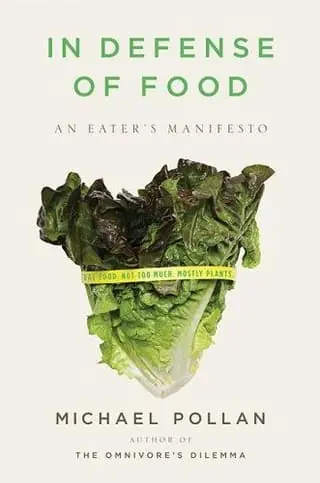
In Defense of Food summary
by Michael Pollan · 2008 · 7 key ideas · 18-minute read
A journalist cuts through decades of confusing nutrition advice with seven words: eat food, not too much, mostly plants.
Why read it
For anyone exhausted by diet fads and conflicting headlines. It offers a calm, common-sense way of eating and explains why nutrition science and the food industry have made eating so confusing.
In Defense of Food in brief
Pollan opens with his answer to the supposedly complicated question of what to eat: eat food, not too much, mostly plants. The rest of the book explains why something so simple has become so confusing, and what each part of that sentence means in practice.
The first part attacks 'nutritionism', the belief that food is essentially a delivery system for nutrients and that we should eat according to scientific advice about fats, carbs, vitamins and so on. Pollan argues that this ideology has served the food industry better than it has served our health.
He traces how official advice shifted from talking about foods to talking about nutrients, how the low-fat era encouraged a flood of processed products, and how nutrition science, for all its effort, struggles to study whole diets eaten by real people over many years.
The second part examines the Western diet of processed foods, refined grains, added sugar and fat, and much less produce. Pollan argues that it is closely tied to the so-called Western diseases, such as obesity, type 2 diabetes and heart disease, and that traditional diets of many kinds tend to keep people healthier.
The final part gives practical rules for escaping the Western diet: avoid products your great-grandmother wouldn't recognise as food, shop at the edges of the supermarket, eat mostly plants, eat meals at a table with others, and cook. The aim is to restore the culture of eating, not just change its chemistry.
The 7 key ideas
1. Seven words
Eat food. Not too much. Mostly plants.
2. The trap of nutritionism
Food is more than the sum of its nutrients.
3. How the advice went wrong
When advice talks nutrients, industry hears opportunity.
4. The Western diet
No perfect diet, but one pattern to escape.
5. Food or food-like substance?
If it shouts about health, it probably isn't food.
6. Mostly plants, especially leaves
Meat as a side dish, plants as the main event.
7. Eat like a culture, not a chemist
Eat at a table, slowly, with friends.
Read the full guide in Kinquire. Every idea with a real example, a diagram and one thing to try today, plus a quick quiz so it sticks. Free to start.
Read In Defense of FoodKey takeaways
- Follow the seven words: eat food, not too much, mostly plants.
- Choose foods with short, familiar ingredient lists, and be wary of health claims on packaging.
- Make plants, especially leafy greens, most of your plate.
- Eat meals at a table, slowly, and with others when you can.
- Cook more of your own food from whole ingredients.
Our take
In Defense of Food has aged unusually well. Its central message, that whole foods, mostly plants and less processed food make for a healthy diet, is echoed by modern guidelines and strengthened by recent research on ultra-processed foods. Its critique of nutritionism remains sharp and useful. Its limits lie in its tone and practicality: some see the great-grandmother test as romanticising the past, and rules like 'pay more, eat less' and 'cook' can feel out of reach for people short on money and time. Pollan is a journalist summarising science rather than a scientist, and a few historical claims simplify complex debates.
About Michael Pollan
Michael Pollan is an American journalist who has taught at the University of California, Berkeley. He is also the author of The Omnivore's Dilemma.
If you liked this
- The Omnivore's Dilemma by Michael Pollan
- Ultra-Processed People by Chris van Tulleken
- How Not to Die by Michael Greger with Gene Stone
- Why We Sleep by Matthew Walker
- Outlive by Peter Attia with Bill Gifford
- Born to Run by Christopher McDougall