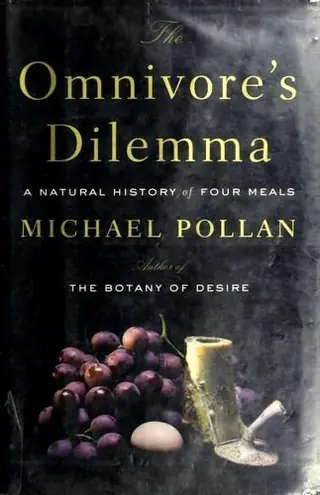
The Omnivore's Dilemma summary
by Michael Pollan · 2006 · 7 key ideas · 19-minute read
By following four meals back to their sources, from a fast-food lunch to a meal he hunted and foraged himself, Pollan reveals the hidden costs of how we feed ourselves.
Why read it
For anyone who wants to understand where their food actually comes from. It changes how you see a supermarket, a burger or an organic label, and invites you to eat more consciously.
The Omnivore's Dilemma in brief
Pollan begins with a problem faced by every omnivore: because we can eat almost anything, we have to decide what to eat. For most of history, culture and tradition answered that question. Today, he argues, the industrial food system has taken over the job and hidden how our food is produced.
To uncover it, he follows four meals back to their origins. The first is industrial: a fast-food meal traced to vast cornfields in Iowa and a cattle feedlot in Kansas. He finds a system built on cheap corn, fossil fuels and government subsidies.
The second meal is industrial organic, bought from a major organic supermarket. Pollan finds that much big organic farming, while avoiding synthetic pesticides, still relies on large monocultures and long supply chains, a long way from the pastoral images on its packaging.
The third meal comes from Polyface Farm in Virginia, where farmer Joel Salatin raises animals on grass in a carefully designed rotation that mimics natural ecosystems. Pollan spends a week working there and sees a radically different model of farming.
For the fourth meal, Pollan hunts a wild pig, gathers mushrooms and forages ingredients himself. The experience forces him to confront the ethics of killing animals and gives him a meal whose full cost he knows. His conclusion is that knowing where food comes from is the first step to eating well.
The 7 key ideas
1. The omnivore's dilemma
We can eat anything, so we must choose.
2. We are what corn makes us
Follow the corn, and you'll find the industrial meal.
3. Steer 534
Cows evolved for grass; corn needs a pharmacy.
4. Eating oil
Cheap food is cheap oil in disguise.
5. Supermarket pastoral
Organic is a rule, not a story.
6. Grass farming
Farm the grass, and the grass farms the animals.
7. Knowing the full cost
Eat as if you'd seen where it came from.
Read the full guide in Kinquire. Every idea with a real example, a diagram and one thing to try today, plus a quick quiz so it sticks. Free to start.
Read The Omnivore's DilemmaKey takeaways
- Find out where some of your food comes from and how it is produced.
- Read ingredient lists for hidden corn products like syrups and starches.
- Look beyond 'organic' labels if you care about scale, locality or animal welfare.
- Buy some food directly from local farmers or markets.
- If you eat meat, eat less of it and choose better-raised animals.
Our take
The Omnivore's Dilemma is one of the most influential food books of its era, praised for vivid reporting and for making the industrial food chain visible. Its exposure of the corn economy, feedlots and 'supermarket pastoral' remains largely accurate. Critics note that it offers few scalable solutions: Polyface-style farming and hunting are not realistic ways to feed billions, and the food Pollan favours costs more than many families can afford. Some agricultural scientists also feel it underplays the benefits of industrial farming, such as feeding more people on less land. As a provocation to pay attention, though, it remains powerful.
About Michael Pollan
Michael Pollan is an American journalist who has taught at the University of California, Berkeley. He later wrote In Defense of Food and Food Rules.
If you liked this
- In Defense of Food by Michael Pollan
- Ultra-Processed People by Chris van Tulleken
- Why We Sleep by Matthew Walker
- Outlive by Peter Attia with Bill Gifford
- Born to Run by Christopher McDougall
- How Not to Die by Michael Greger with Gene Stone