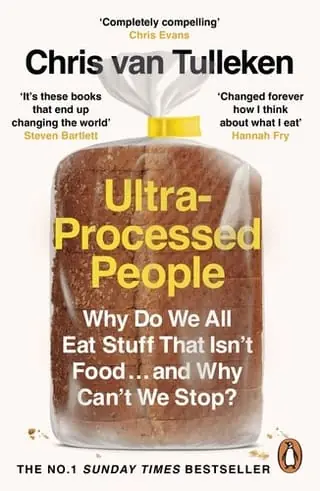
Ultra-Processed People summary
by Chris van Tulleken · 2023 · 7 key ideas · 18-minute read
A doctor argues that ultra-processed food, now most of what many people eat, is engineered to be overeaten and is driving diet-related disease, and that the problem is the food system, not personal willpower.
Why read it
For anyone who has wondered why it's so hard to stop eating certain foods. It changes how you read a supermarket shelf, though the science of exactly how ultra-processed food harms us is still developing.
Ultra-Processed People in brief
Van Tulleken starts with a definition. Ultra-processed food, or UPF, is a category from a Brazilian food classification system called NOVA. In simple terms, it's food that comes in packaging and contains at least one ingredient you wouldn't usually find in a home kitchen, such as emulsifiers, modified starches or flavourings. He argues that UPF now makes up more than half of what people eat in countries like the UK and US.
He then explores why UPF is a problem. Drawing on research, including a key controlled trial, he argues that people eating UPF tend to eat more calories and gain weight, probably because these foods are soft, energy-dense, quick to eat and engineered to be irresistible, which may override the body's fullness signals.
To experience this himself, he eats a diet very high in UPF for a month, reporting weight gain, poor sleep and feeling unwell. He also examines additives and their possible effects on the gut, and the strange history of how industrial ingredients entered our diets.
The second half turns to the food system. He argues that food companies are driven to maximise sales, and that the most profitable products are cheap, long-lasting, heavily marketed UPF. He criticises industry funding of research and health organisations, and compares the situation to tobacco.
His conclusion is that obesity and diet-related disease are not mainly failures of personal willpower, and that real change requires regulation. For individuals, he takes an unusual approach: rather than giving rules, he hopes understanding how UPF is made will make readers want less of it.
The 7 key ideas
1. What counts as ultra-processed
Plastic wrapper plus an unfamiliar ingredient usually means UPF.
2. We eat more of it
Same nutrients on paper, more calories in the body.
3. Soft, fast and engineered
Fast food outruns the full signal.
4. Additives and the gut
Short ingredient lists, fewer unknowns.
5. It's not your fault
Blame the system before you blame yourself.
6. Understanding over willpower
Know what's in it, and the craving loosens.
7. Change the system
Make the healthy choice the easy choice.
Read the full guide in Kinquire. Every idea with a real example, a diagram and one thing to try today, plus a quick quiz so it sticks. Free to start.
Read Ultra-Processed PeopleKey takeaways
- Read ingredient lists and notice ingredients you'd never use at home.
- Swap one ultra-processed staple, like breakfast cereal or a snack, for a whole-food alternative.
- Eat slowly and with attention, especially with soft, energy-dense foods.
- Don't blame yourself for cravings; recognise the role of food design and marketing.
- Support policies that make real food cheaper and easier to choose.
Our take
Ultra-Processed People is a vivid, compassionate book that shifts blame for diet-related disease from individuals to the food system, and it popularised a concept that is now central to nutrition debates. Its strongest evidence, the NIH trial and many observational studies, supports eating less UPF. Its weaknesses: the UPF category is broad and contested, much of the evidence on mechanisms and additives is early, and the author's month-long experiment proves little. Critics also worry it can make affordable convenience foods sound frightening. It's best read as a powerful argument for eating more real food and for better regulation, not as settled science.
About Chris van Tulleken
Chris van Tulleken is a British doctor specialising in infectious diseases and an associate professor at University College London. He is also a BBC science and health presenter.
If you liked this
- In Defense of Food by Michael Pollan
- The Omnivore's Dilemma by Michael Pollan
- The Obesity Code by Jason Fung
- Why We Sleep by Matthew Walker
- Outlive by Peter Attia with Bill Gifford
- Born to Run by Christopher McDougall