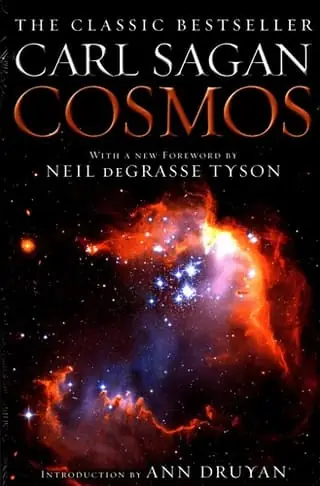
Cosmos summary
by Carl Sagan · 1980 · 8 key ideas · 21-minute read
A sweeping, lyrical tour of the universe and of the people who figured it out, arguing that science is humanity's best way of knowing where we stand.
Why read it
For anyone who wants awe and understanding at once: the story of stars, planets and life, told alongside the human history of discovery, by the great science communicator of his era.
Cosmos in brief
Sagan invites us to the shore of the cosmic ocean. The universe is vast and old, and Earth is a tiny world in it. Rather than finding this depressing, he finds it thrilling — and he argues that the human ability to understand it is one of the universe's most remarkable features.
The book moves back and forth between the cosmos and the people who studied it. We meet Eratosthenes measuring the Earth with shadows, Kepler wrestling his beloved theories against stubborn data, the early Greek thinkers of Ionia who first tried to explain nature without gods, and the great Library of Alexandria, whose loss Sagan mourns as a lesson in how knowledge can disappear.
Along the way he explains evolution, the planets of our solar system, the life cycles of stars, the nature of space and time, and the big bang. A central theme is connection: the atoms in our bodies were forged inside earlier generations of stars, so we are literally made of star stuff.
Sagan also asks whether we are alone. He describes the search for life on Mars, the hellish greenhouse of Venus, the Drake equation for estimating alien civilizations, and how we might communicate across interstellar distances. Throughout, he treats the question with open-minded curiosity but insists on evidence before belief.
He ends with a warning and a hope. Humanity now holds the power to destroy itself, especially through nuclear weapons. Seen from the cosmic perspective, national quarrels look small, and Sagan argues we must speak for Earth as a whole, using science and reason to survive.
The 8 key ideas
1. Science is a way of thinking
A stick, a shadow and a question can measure a world.
2. We are made of star stuff
Your atoms have been to the stars.
3. Selection shapes life
No designer needed — just variation and a filter.
4. Let the data win
When theory and data fight, back the data.
5. Knowledge can be lost
Knowledge unshared is knowledge at risk.
6. Neighbours as warnings
Venus is what a greenhouse looks like with the doors locked.
7. Are we alone?
Big questions shrink when you split them.
8. Who speaks for Earth?
One planet, one species, one future.
Read the full guide in Kinquire. Every idea with a real example, a diagram and one thing to try today, plus a quick quiz so it sticks. Free to start.
Read CosmosKey takeaways
- Measure something you usually guess, in the spirit of Eratosthenes.
- When cherished beliefs clash with good data, side with the data.
- Break overwhelming questions into smaller factors you can estimate.
- Protect and share knowledge; it can be lost faster than it was gained.
- Use the cosmic perspective to shrink petty conflicts and enlarge shared concerns.
Our take
Cosmos remains one of the great works of science writing: poetic, clear and generous, it made millions of people feel the universe was theirs to understand. Its science on stars and planets has largely held up, though details have been superseded, and its Cold War framing feels dated. Its history is more romantic than precise: historians criticise the tidy story of the Ionians, the Library of Alexandria and Hypatia, and the Heike crab tale is doubtful. Some readers find Sagan's sweeping lyricism over-rich. Read it for perspective and inspiration, checking specific historical claims elsewhere.
About Carl Sagan
Carl Sagan (1934–1996) was an American astronomer and planetary scientist at Cornell University who worked on NASA missions including Viking and Voyager. Cosmos accompanied his 1980 television series of the same name.
If you liked this
- The Demon-Haunted World by Carl Sagan
- A Brief History of Time by Stephen Hawking
- Astrophysics for People in a Hurry by Neil deGrasse Tyson
- The Selfish Gene by Richard Dawkins
- A Short History of Nearly Everything by Bill Bryson
- The Gene by Siddhartha Mukherjee