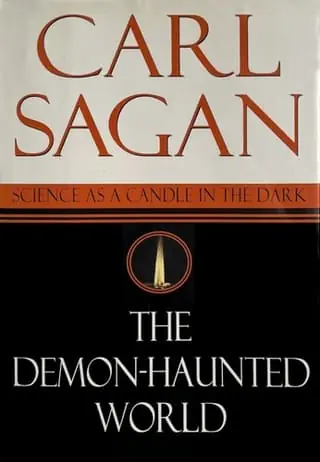
The Demon-Haunted World summary
by Carl Sagan · 1995 · 8 key ideas · 20-minute read
A passionate defence of scientific thinking as a 'candle in the dark' against superstition, pseudoscience and manipulation — with a practical toolkit for spotting nonsense.
Why read it
For anyone who wants to think more clearly in an age of misinformation, and to learn how to be open-minded without being gullible.
The Demon-Haunted World in brief
Sagan worries that many people, though hungry for wonder, are drawn to pseudoscience — UFO abductions, faces on Mars, channelled spirits, miracle cures — rather than to real science, which is stranger and more wonderful. The problem, he argues, is not curiosity but a lack of tools to tell good evidence from bad.
He walks through popular beliefs and shows how ordinary features of human perception and memory — seeing faces in patterns, hallucinating during sleep, misremembering — can produce vivid experiences that feel real but aren't. He links modern alien abduction stories to older tales of demons and witches, and recalls how witch hunts tortured and killed innocent people.
At the heart of the book is his 'baloney detection kit': a set of mental tools for testing claims, plus a catalogue of common logical fallacies. He insists that science requires a balance of two attitudes: openness to new ideas, however strange, and ruthless scepticism toward all of them.
Sagan ends with democracy. Citizens who can't evaluate evidence are vulnerable to charlatans and demagogues. Teaching science and critical thinking, he argues, is not just about producing scientists; it is about protecting freedom. He draws on the story of Frederick Douglass, for whom learning to read was the path out of slavery.
The 8 key ideas
1. Science is a candle in the dark
Science's power is that it can be wrong — and find out.
2. Pack a baloney detection kit
Before you believe, check the kit.
3. Know the classic fallacies
Name the trick and it loses its grip.
4. The dragon in my garage
If nothing could disprove it, it proves nothing.
5. Our minds can fool us
Feeling real isn't the same as being real.
6. The demons we used to see
Demanding evidence is a form of kindness.
7. Marry scepticism and wonder
Open minds, sharp questions.
8. Science protects freedom
A free mind is a questioning mind.
Read the full guide in Kinquire. Every idea with a real example, a diagram and one thing to try today, plus a quick quiz so it sticks. Free to start.
Read The Demon-Haunted WorldKey takeaways
- Run the baloney detection kit on claims before you believe or share them.
- Learn to name common fallacies, especially in arguments you agree with.
- Ask what evidence would change your mind about any belief.
- Remember that vivid experiences and confident memories can still be wrong.
- Balance openness with scepticism, and encourage curiosity in others.
Our take
This is one of the best guides to sceptical thinking ever written, warm rather than sneering, and its baloney detection kit has aged remarkably well into the misinformation era. Its examples are rooted in the 1990s — UFOs, crop circles, recovered memories — so some feel dated, and it says little about the social and emotional reasons people hold beliefs, which later research shows evidence alone rarely changes. Some readers find it repetitive and occasionally preachy. Its broader concern for scientific literacy and democracy, however, reads as more urgent now than when it was written.
About Carl Sagan
Carl Sagan (1934–1996) was an American astronomer at Cornell University and one of the best-known science communicators of the twentieth century. This was one of his last books, published the year before he died.
If you liked this
- Cosmos by Carl Sagan
- Thinking, Fast and Slow by Daniel Kahneman
- A Brief History of Time by Stephen Hawking
- The Selfish Gene by Richard Dawkins
- A Short History of Nearly Everything by Bill Bryson
- The Gene by Siddhartha Mukherjee