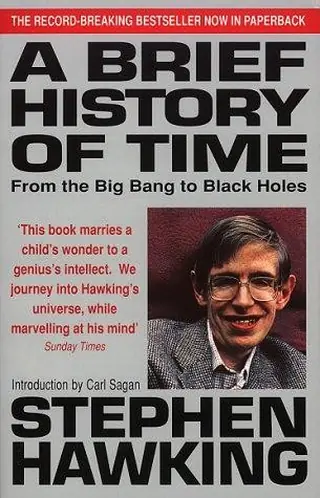
A Brief History of Time summary
by Stephen Hawking · 1988 · 8 key ideas · 24-minute read
A tour of how physics came to understand space, time, black holes and the birth of the universe — and the hunt for one theory that explains it all.
Why read it
For anyone who has wondered where the universe came from, what a black hole really is, or why time only flows one way, explained by one of the physicists who shaped the answers.
A Brief History of Time in brief
Hawking starts with the oldest questions: what is the universe, where did it come from, and will it end? He explains what a scientific theory actually is — a model that fits observations and makes predictions that could prove it wrong — and then walks through how our picture changed from Aristotle and Ptolemy, through Copernicus, Galileo and Newton, to Einstein.
Einstein's relativity is the turning point. Space and time are not a fixed stage but a single flexible fabric, spacetime, that mass and energy bend. Gravity is that bending. Combine this with Edwin Hubble's discovery that galaxies are moving apart, and the equations point backwards to a hot, dense beginning: the big bang, where our known laws break down.
The other pillar of modern physics, quantum mechanics, says nature at small scales is fundamentally uncertain. Hawking explains the uncertainty principle, the particles that make up matter, and the four forces that act between them, and why physicists believe these forces may be facets of one deeper law.
The heart of the book is black holes. Hawking describes how massive stars collapse, what an event horizon is, and his own surprising discovery: when quantum effects are included, black holes are not completely black but slowly leak radiation and can, in principle, evaporate.
He closes with the biggest puzzles: why time has a direction, whether the universe needs a boundary or a beginning at all (his and James Hartle's no-boundary proposal), and the search for a complete unified theory. If we found it, he writes, it would be a triumph of human reason that everyone, not just scientists, should be able to discuss.
The 8 key ideas
1. A theory is a model you can break
Good theories stick their necks out.
2. Space and time bend together
Mass bends spacetime; bent spacetime steers mass.
3. The universe had a hot beginning
Expanding now means crowded then.
4. Nature is uncertain at heart
At the smallest scales, nature deals in odds, not certainties.
5. Black holes trap light
Past the horizon, every road leads inward.
6. Black holes aren't so black
Even the darkest object leaks a little light.
7. Time has arrows
Broken cups don't jump back onto tables.
8. The search for one theory
Two great theories, one universe — something has to give.
Read the full guide in Kinquire. Every idea with a real example, a diagram and one thing to try today, plus a quick quiz so it sticks. Free to start.
Read A Brief History of TimeKey takeaways
- Judge any theory by what it predicts and what could prove it wrong, not by how confident it sounds.
- Think of space and time as flexible and linked, not as a fixed backdrop.
- Expect nature at small scales to deal in probabilities, and do the same with your own forecasts.
- Admit and publish your mistakes; Hawking shows it strengthens rather than weakens credibility.
- Keep asking the big 'why' questions — Hawking thought they belonged to everyone, not just experts.
Our take
Hawking wrote a genuinely ambitious popular book: almost no equations (his editor warned each would halve sales, so he kept only E = mc²) and a willingness to show his own mistakes. The early chapters on relativity and expansion remain clear and accurate. But it is famously one of the most-bought, least-finished books; the chapters on particles and imaginary time are dense. Some ideas have dated: dark energy and the universe's precise age came later, Hawking radiation is still unobserved, and the no-boundary proposal remains speculative. Treat the final chapters as a brilliant physicist's best guesses, not settled science.
About Stephen Hawking
Stephen Hawking (1942–2018) was a Cambridge cosmologist who held the Lucasian Professorship of Mathematics, the chair once held by Isaac Newton. He was diagnosed with motor neurone disease (ALS) at 21 and did most of his career's work while severely disabled.
If you liked this
- The Elegant Universe by Brian Greene
- Seven Brief Lessons on Physics by Carlo Rovelli
- Cosmos by Carl Sagan
- Astrophysics for People in a Hurry by Neil deGrasse Tyson
- The Selfish Gene by Richard Dawkins
- A Short History of Nearly Everything by Bill Bryson