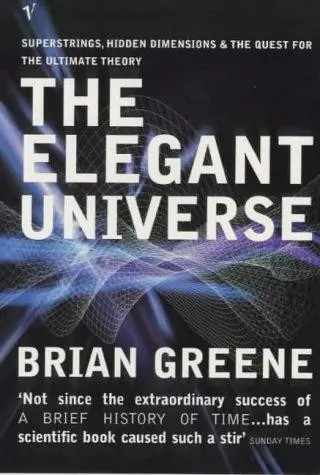
The Elegant Universe summary
by Brian Greene · 1999 · 8 key ideas · 20-minute read
A guided tour of string theory — the bold idea that everything is made of tiny vibrating strings in extra dimensions — and why physicists hope it could unite all of physics.
Why read it
For readers who want to understand the deepest open problem in physics, how relativity and quantum mechanics clash, and the most famous attempt to resolve it, with clever analogies instead of equations.
The Elegant Universe in brief
Greene begins with a crisis at the heart of physics. Two theories — general relativity, which describes gravity and the large-scale universe, and quantum mechanics, which describes the very small — are both superbly confirmed, yet they are mathematically incompatible. Where both matter, as in black holes or the big bang, they give nonsense.
To set the stage, he explains each theory with vivid analogies: special relativity's strange effects on time and space, general relativity's curved spacetime, and the frantic quantum jitters of the microscopic world. The clash comes at extremely small distances, where quantum jitters violently disturb the smooth geometry relativity requires.
String theory proposes a solution: the fundamental ingredients of nature are not point particles but tiny vibrating loops of string. Different vibration patterns appear to us as different particles, including one that behaves like the graviton, the carrier of gravity. Because strings have size, they smear out the tiniest-scale jitters, taming the conflict.
The theory has strange requirements and consequences: extra curled-up dimensions of space, a minimum meaningful size, the possibility that space can tear and repair itself, and a deeper framework called M-theory that unifies five versions of string theory. Greene is candid that none of this has been tested by experiment, and closes with the challenges and hopes for a final theory.
The 8 key ideas
1. Two great theories clash
Two right theories, one wrong combination.
2. We all move at light speed
Speed through space is borrowed from time.
3. Space is frantic up close
Look close enough and space boils.
4. Everything is vibrating strings
Particles are notes; the universe is the music.
5. Hidden dimensions
Small enough is invisible, not absent.
6. Strings soften the smallest scales
Below the string scale, 'smaller' stops making sense.
7. Space can tear
Strings make even torn space survivable.
8. One theory — still untested
Elegant is not the same as proven.
Read the full guide in Kinquire. Every idea with a real example, a diagram and one thing to try today, plus a quick quiz so it sticks. Free to start.
Read The Elegant UniverseKey takeaways
- Notice when two trusted models give contradictory answers — that's where breakthroughs hide.
- Use analogies to grasp abstract ideas, but know where they break.
- Look for hidden dimensions in problems: what looks one-dimensional may have more depth up close.
- Value elegance, but insist on experimental evidence.
- Read critics alongside advocates on any unproven frontier.
Our take
The Elegant Universe is a landmark of science writing: Greene's analogies for relativity and quantum mechanics are among the clearest ever written, and he conveys the excitement of string theory from the inside. Its weakness is enthusiasm. More than two decades on, string theory has produced no experimental confirmation, the Large Hadron Collider found no supersymmetry, and the theory appears to allow a vast 'landscape' of possible universes, undermining hopes of unique predictions. Greene acknowledges uncertainty, but readers should treat later chapters as an advocate's case, and read critics alongside.
About Brian Greene
Brian Greene is an American theoretical physicist at Columbia University who has worked on string theory. He co-founded the World Science Festival in New York.
If you liked this
- A Brief History of Time by Stephen Hawking
- Seven Brief Lessons on Physics by Carlo Rovelli
- The Selfish Gene by Richard Dawkins
- Cosmos by Carl Sagan
- A Short History of Nearly Everything by Bill Bryson
- The Gene by Siddhartha Mukherjee