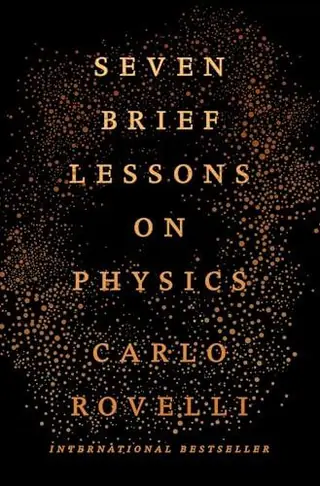
Seven Brief Lessons on Physics summary
by Carlo Rovelli · 2014 · 7 key ideas · 18-minute read
Seven short, lyrical essays on the great revolutions of modern physics — relativity, quantum theory, the cosmos, particles, quantum gravity, time — and what they mean for us.
Why read it
For curious readers who want the big ideas of twentieth-century physics in a single sitting, explained with poetry rather than equations, by a physicist working at the frontier.
Seven Brief Lessons on Physics in brief
Rovelli wrote these lessons for people who know little about modern science. In seven short chapters, first published in Italian, he sketches the biggest shifts in how physics sees the world. The English translation keeps his conversational, almost poetic voice.
He starts with Einstein's general relativity, which he calls the most beautiful of theories: gravity is not a force in space but the curving of space itself. Then quantum mechanics, which revealed that the world at small scales is grainy, probabilistic and made of interactions rather than solid things.
Next he zooms out to the architecture of the cosmos, from Anaximander's floating Earth to an expanding universe of galaxies, and then zooms in to the particles described by the Standard Model, which he presents as astonishingly successful but untidy, a patchwork that still leaves gravity and dark matter out.
The last three lessons go to the edge of knowledge. Rovelli describes loop quantum gravity, his own field, which suggests space is made of tiny indivisible grains. He explores how heat, probability and our blurred view of the world may explain why time seems to flow. And he ends with us — part of nature, curious, and standing at the edge of what we know.
The 7 key ideas
1. Gravity is the shape of space
Space isn't the stage; it's one of the actors.
2. The world is made of jumps
Reality is made of events, not things.
3. Our map of the cosmos keeps growing
Every new map makes us smaller and wiser.
4. Particles are ripples in fields
Matter is a dance of ripples, not a pile of marbles.
5. Space may come in grains
Maybe even space has atoms.
6. Time flows because we see blurrily
Time's arrow is drawn in heat.
7. We are part of nature
We are nature, curious about itself.
Read the full guide in Kinquire. Every idea with a real example, a diagram and one thing to try today, plus a quick quiz so it sticks. Free to start.
Read Seven Brief Lessons on PhysicsKey takeaways
- See space and time as dynamic, not as a fixed backdrop.
- Think of reality as interactions and events, not just things.
- Hold even the best current theories as steps, not final answers.
- Know which ideas are established and which are one expert's bet.
- Cultivate curiosity — standing at the edge of knowledge is part of being human.
Our take
This tiny book became an international bestseller because it conveys the beauty of physics without equations, and Rovelli writes with rare warmth. Its brevity is also its limit: concepts are sketched, not explained, so readers may come away inspired but not able to explain much. Two lessons — on grains of space and on time — present Rovelli's own research views, which are serious but unconfirmed and contested; string theorists would tell the story differently. The closing reflections on free will are elegant but brief. Treat it as a beautiful doorway, then go deeper with his longer books.
About Carlo Rovelli
Carlo Rovelli is an Italian theoretical physicist and one of the founders of loop quantum gravity, an approach to uniting gravity with quantum theory. He has worked in Italy, the United States and France.
If you liked this
- A Brief History of Time by Stephen Hawking
- The Elegant Universe by Brian Greene
- The Selfish Gene by Richard Dawkins
- Cosmos by Carl Sagan
- A Short History of Nearly Everything by Bill Bryson
- The Gene by Siddhartha Mukherjee