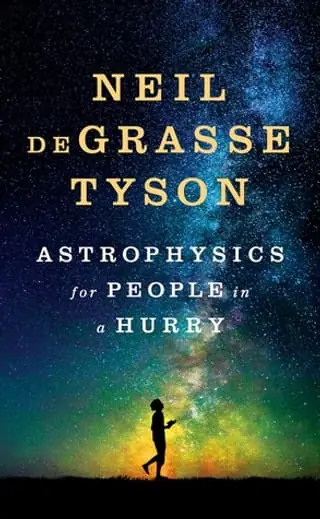
Astrophysics for People in a Hurry summary
by Neil deGrasse Tyson · 2017 · 8 key ideas · 20-minute read
A short, witty tour of the universe — from the big bang to dark energy — and a case for the cosmic perspective.
Why read it
For busy people who want a quick, reliable grounding in what astrophysicists know and don't know, plus a dose of perspective on our place in the cosmos.
Astrophysics for People in a Hurry in brief
Tyson promises the essentials of astrophysics in bite-sized chapters you could read while your coffee brews. He begins at the very beginning: the universe as an unimaginably hot, dense speck that expanded and cooled, letting forces separate, particles form, and eventually hydrogen and helium fill space.
He then explains why astrophysics is possible at all. The same laws of physics apply everywhere, so light from distant stars can be decoded to reveal what they're made of. Telescopes now see across the whole spectrum, from radio waves to gamma rays, revealing a universe invisible to our eyes.
The middle chapters confront the two biggest mysteries. Dark matter is something unseen whose gravity holds galaxies together. Dark energy is a mysterious pressure that is accelerating the expansion of the universe. Together they make up most of the cosmos, and we don't know what either is.
Tyson also walks through the periodic table as a cosmic story, explains why planets and stars are round, tours the space between planets and between galaxies, and asks what aliens would see if they looked at Earth — a thought experiment that doubles as a lesson in how we hunt for life elsewhere.
He ends with the cosmic perspective: knowing we are small in a vast universe but chemically connected to it. He argues this view should make us humbler, kinder and more curious, and less inclined to the petty conflicts that divide people on our small planet.
The 8 key ideas
1. Everything began small and hot
We are the leftovers of a near-perfect cancellation.
2. The same laws, everywhere
Same rules here as out there.
3. Most light is invisible
What you can't see can still shine.
4. Dark matter holds galaxies together
We measure its pull, but not its nature.
5. Dark energy speeds things up
Most of the universe is a mystery with a name.
6. The elements tell a story
The periodic table is a family tree of stars.
7. Is anybody out there?
From far away, life is a whisper in starlight.
8. Adopt the cosmic perspective
Small in size, vast in connection.
Read the full guide in Kinquire. Every idea with a real example, a diagram and one thing to try today, plus a quick quiz so it sticks. Free to start.
Read Astrophysics for People in a HurryKey takeaways
- Look up at the night sky regularly to keep perspective.
- Remember that most of what's out there — and in many fields — is still unknown.
- Treat light as a messenger: much of what we know comes from reading it.
- Be humble about what you can't see but can infer from its effects.
- Use the cosmic perspective to shrink everyday conflicts and grow curiosity.
Our take
This is an efficient, entertaining primer that covers a lot of ground in very few pages, and Tyson's enthusiasm is infectious. The trade-off is depth: concepts like inflation, quantum fields or dark energy get only a paragraph or two, and some readers find the jokey, breezy tone glib. The final chapter is more personal philosophy than science. The science itself is mainstream and accurate as of 2017, though open questions such as the nature of dark matter and the precise expansion rate of the universe have only grown more interesting since.
About Neil deGrasse Tyson
Neil deGrasse Tyson is an American astrophysicist and director of the Hayden Planetarium at the American Museum of Natural History in New York. He hosted the 2014 TV series Cosmos: A Spacetime Odyssey.
If you liked this
- Cosmos by Carl Sagan
- A Brief History of Time by Stephen Hawking
- Seven Brief Lessons on Physics by Carlo Rovelli
- The Selfish Gene by Richard Dawkins
- A Short History of Nearly Everything by Bill Bryson
- The Gene by Siddhartha Mukherjee