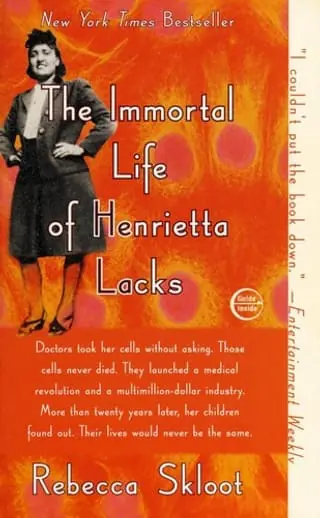
The Immortal Life of Henrietta Lacks summary
by Rebecca Skloot · 2010 · 8 key ideas · 21-minute read
The story of a poor Black tobacco farmer whose cancer cells, taken without her knowledge in 1951, became one of the most important tools in medicine — and of the family left in the dark.
Why read it
For anyone who benefits from modern medicine (everyone) and wants to understand the human, racial and ethical story behind it, from consent to who profits from our bodies.
The Immortal Life of Henrietta Lacks in brief
In 1951 Henrietta Lacks, a 30-year-old Black mother of five, went to Johns Hopkins Hospital in Baltimore with a lump in her cervix. It was an aggressive cancer. During her treatment, doctors took samples of her tumour without telling her and passed them to a researcher who had been trying, without success, to keep human cells alive in the lab. Henrietta died that October, aged 31.
Her cells, named HeLa, did something no human cells had done before: they kept dividing indefinitely. They became the first 'immortal' human cell line and were shared with labs worldwide. HeLa helped test the polio vaccine and contributed to advances in cancer research, virology, gene mapping and much more. Companies grew and sold them.
Henrietta's family knew nothing of this for over twenty years. Skloot spent a decade earning their trust, especially that of Henrietta's daughter Deborah, who longed to know who her mother was and what had happened to her sister Elsie, institutionalised as a child.
The book braids three strands: Henrietta's life, the scientific history of HeLa, and Skloot's journey with the family. Together they raise hard questions about consent, race, poverty, medical ethics and who should benefit when our bodies fuel discovery. Skloot lets the family speak in their own words and leaves many of those questions open.
The 8 key ideas
1. Behind every sample is a person
Data has a face, even when we forget it.
2. Cells that wouldn't die
Her cells kept living so others could too.
3. Consent: then and now
Legal then doesn't mean right now.
4. Who profits from our bodies?
If your body has value, you deserve to know.
5. Race, poverty and mistrust
Trust is earned by honesty about the past.
6. Abuses forced the rules
Rules are often written by those who refused.
7. Too good to contain
Verify the tools, not just the results.
8. Knowledge as care
Explaining is a form of respect.
Read the full guide in Kinquire. Every idea with a real example, a diagram and one thing to try today, plus a quick quiz so it sticks. Free to start.
Read The Immortal Life of Henrietta LacksKey takeaways
- Remember the people behind data, samples and statistics.
- Read consent forms for medical care and apps, and ask how your samples or data may be used.
- Take others' mistrust seriously by learning its history before dismissing it.
- Verify the tools and sources you rely on, not just the results.
- Explain technical matters plainly to those affected — it's a form of respect.
Our take
Skloot turns a hidden history into a gripping, humane narrative and has helped change public debate about consent and tissue research. She is fair to the scientists, noting that 1951 practices were legal and that HeLa did immense good. Some readers find that Skloot's own presence in the story looms large, and some members of the Lacks family have publicly criticised aspects of how the story has been told and who has profited from it. The book raises policy questions more than it answers them, and some details have been overtaken by later events, including the 2013 genome agreement and the 2023 legal settlement.
About Rebecca Skloot
Rebecca Skloot is an American science writer. This was her first book; it became a long-running bestseller and was adapted into a 2017 HBO film starring Oprah Winfrey.
If you liked this
- The Emperor of All Maladies by Siddhartha Mukherjee
- The Gene by Siddhartha Mukherjee
- A Brief History of Time by Stephen Hawking
- The Selfish Gene by Richard Dawkins
- Cosmos by Carl Sagan
- A Short History of Nearly Everything by Bill Bryson