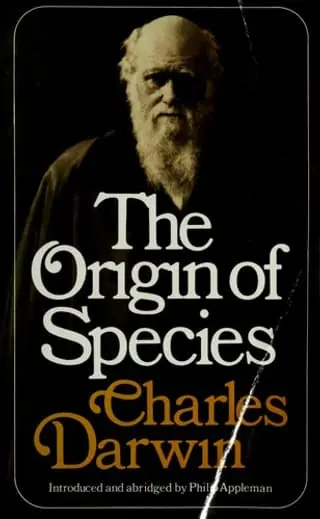
On the Origin of Species summary
by Charles Darwin · 1859 · 7 key ideas · 18-minute read
Darwin's 'one long argument' that species are not fixed but descend from common ancestors, shaped over immense time by natural selection.
Why read it
For anyone who wants to understand the idea that underpins all of modern biology, in the patient, evidence-packed form in which it was first presented — and to see a masterclass in building and testing an argument.
On the Origin of Species in brief
Darwin starts with something his readers knew well: domestic breeding. Pigeon fanciers, dog breeders and farmers had produced dramatically different varieties by choosing which animals to breed. Variation clearly exists, and much of it is inherited. If humans can shape living things in a few centuries, what could nature do over far longer spans?
He then introduces the struggle for existence. Every species produces far more offspring than can survive. Any slight inherited advantage in finding food, escaping predators or attracting mates will tend to be passed on. He calls this preservation of favourable variations natural selection. Over many generations, it can produce new varieties and, eventually, new species.
Darwin devotes much of the book to objections. How could complex organs like the eye evolve? Why don't we see endless transitional forms in the fossil record? Why are hybrids often sterile? He answers each with evidence, admitting where knowledge is incomplete.
He then marshals evidence from many fields: the geographical distribution of species, the fossil record, classification, embryology and rudimentary organs. All fit naturally if species share common ancestors, and make little sense if each was created separately. He closes with a famous vision of life as a tangled bank, from which endless forms have evolved. Note that Darwin revised the book through six editions; wording differs between them.
The 7 key ideas
1. Breeders show the way
If breeders can do it in centuries, nature can in millennia.
2. Too many are born
Many are born, few survive — and not by chance.
3. Natural selection
Tiny edges, kept and multiplied, become new forms.
4. Life is a branching tree
Every living thing is a cousin.
5. Face the hardest objections
Name your weak points before others do.
6. Where species live tells a story
Islands are evolution's natural experiments.
7. Grandeur in this view of life
Endless forms, one family, still evolving.
Read the full guide in Kinquire. Every idea with a real example, a diagram and one thing to try today, plus a quick quiz so it sticks. Free to start.
Read On the Origin of SpeciesKey takeaways
- Look for small, cumulative changes behind big outcomes.
- Build arguments from many independent lines of evidence.
- Confront the strongest objections to your ideas openly.
- Think of competition and survival as filters that shape what persists.
- Find wonder, not bleakness, in understanding how things came to be.
Our take
Origin is one of the most important books ever written, and its central claims — common descent and natural selection — are confirmed by every field of biology since, including genetics and DNA. Its style is Victorian and dense, with long lists of examples. Darwin's biggest gap was inheritance: he didn't know how traits were passed on, and the 'pangenesis' hypothesis he proposed later was wrong. He also underestimated non-gradual changes and the role of chance. Read it for the argument's architecture and Darwin's exemplary honesty about difficulties, ideally in the first edition, since later editions added replies to critics.
About Charles Darwin
Charles Darwin (1809–1882) was an English naturalist whose five-year voyage on HMS Beagle shaped his thinking. He later extended his ideas to humans in The Descent of Man (1871).
If you liked this
- The Selfish Gene by Richard Dawkins
- A Brief History of Time by Stephen Hawking
- Cosmos by Carl Sagan
- A Short History of Nearly Everything by Bill Bryson
- The Gene by Siddhartha Mukherjee
- Astrophysics for People in a Hurry by Neil deGrasse Tyson