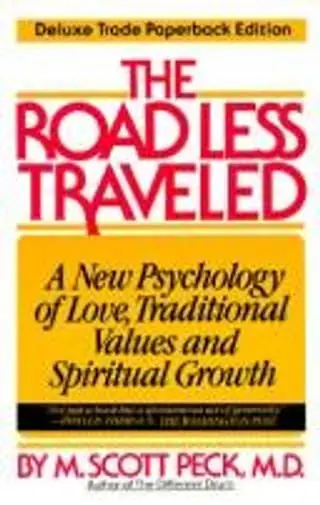
The Road Less Traveled summary
by M. Scott Peck · 1978 · 8 key ideas · 20-minute read
Life is difficult, and growth comes from facing that difficulty with discipline, honest responsibility and a demanding kind of love — the will to nurture your own and others' growth.
Why read it
For anyone who wants a wise, unsentimental guide to maturity, relationships and personal growth from a psychiatrist who blends therapy with spirituality.
The Road Less Traveled in brief
The book opens with three famous words: life is difficult. Peck argues that most people refuse to accept this, and spend their lives complaining that problems shouldn't exist. Once we truly accept that life is difficult, he says, the fact no longer matters so much — and we can get on with solving problems, which is how we grow.
The first part is about discipline, which Peck sees as the basic set of tools for solving life's problems. He names four: delaying gratification, accepting responsibility, dedication to truth (keeping your 'map' of reality accurate) and balancing. Without them, we avoid pain — and avoiding necessary pain is, in his view, the root of much mental illness.
The second part is about love. Peck defines it not as a feeling but as the will to extend yourself for the purpose of nurturing your own or another's spiritual growth. He argues that falling in love, dependency and self-sacrifice are often mistaken for love but are something else.
The third part explores growth and religion. Peck sees everyone as having a worldview — a 'religion' in the broad sense — that should keep maturing as we encounter new experiences, sometimes by questioning what we were raised to believe.
The final part, on grace, describes forces that seem to help us grow beyond our own efforts: our resistance to illness, the wisdom of the unconscious, and fortunate coincidences. The main enemy of growth, he concludes, is laziness — our resistance to the effort that real growth requires.
The 8 key ideas
1. Life is difficult
Life is difficult. Accept it, and start.
2. Delay gratification
Eat the cake before the frosting.
3. Take responsibility
If it's yours to solve, own it.
4. Keep your map up to date
Old maps get you lost in new places.
5. Balancing: the art of giving up
To take the turn, give up some speed.
6. Love is an act of will
Love is what you do for someone's growth.
7. Falling in love isn't love
The spark fades; the choice begins.
8. Laziness is the real enemy
Laziness hides as caution; growth asks for effort.
Read the full guide in Kinquire. Every idea with a real example, a diagram and one thing to try today, plus a quick quiz so it sticks. Free to start.
Read The Road Less TraveledKey takeaways
- Accept that life is difficult and treat problems as the raw material for growth.
- Do the unpleasant task first each day.
- Separate what is genuinely your responsibility from what isn't — and act on yours.
- Regularly question whether your reactions come from an outdated map.
- Practise love as attention: listen fully, without your own agenda.
- Notice where laziness is disguised as caution and take one step forward.
Our take
The Road Less Traveled offers unusually clear, demanding wisdom: its ideas on delaying gratification, responsibility and love as an act of will remain useful, and its opening line is justly famous. Peck writes with honesty and warmth, drawing on real therapy cases. Its weaknesses: some of its psychiatric views reflect the 1970s, and its later sections on grace, the unconscious and miracles blend psychology with spiritual speculation that many readers won't accept. Peck's demanding standards can sound moralising, and he later acknowledged personal failings that sat uneasily with his advice. Read selectively, it remains a strong guide to maturity.
About M. Scott Peck
M. Scott Peck (1936–2005) was an American psychiatrist who served in the US Army Medical Corps before going into private practice. The Road Less Traveled, his first book, became one of the best-selling self-help books of its era.
If you liked this
- Man's Search for Meaning by Viktor E. Frankl
- The Four Agreements by Don Miguel Ruiz
- Atomic Habits by James Clear
- Meditations by Marcus Aurelius
- Letters from a Stoic by Seneca
- The Enchiridion by Epictetus