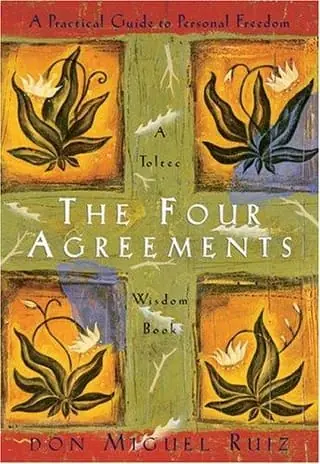
The Four Agreements summary
by Don Miguel Ruiz · 1997 · 7 key ideas · 19-minute read
We suffer because of thousands of unconscious beliefs we absorbed as children; four simple new agreements with ourselves can break their hold and set us free.
Why read it
For anyone tired of overthinking, people-pleasing or feeling hurt by what others say — it offers four memorable rules you can practise from today.
The Four Agreements in brief
Ruiz begins with an idea he calls the dream of the planet. Every human lives in a kind of dream shaped by society — its rules, beliefs and judgments. As children we did not choose these beliefs; we agreed to them because adults rewarded and punished us. He calls this process the domestication of humans.
Those agreements now run our lives. Inside each of us, an inner Judge enforces the rules and an inner Victim carries the blame and shame. We punish ourselves many times over for the same mistake, and much of our suffering comes from these old, unexamined agreements rather than from reality.
To break free, Ruiz proposes four new agreements. Be impeccable with your word. Don't take anything personally. Don't make assumptions. Always do your best. Each one targets a common source of pain: careless speech, hurt pride, misunderstanding and self-punishment. Simple to state, he admits, they are hard to live by.
The fourth agreement holds the others together. Your best changes from moment to moment — it will be different when you are sick or tired — but if you always do your best, you avoid self-judgment and regret, and the other agreements gradually become habit.
The final chapters describe the path of change: becoming aware of your old agreements, practising the new ones even when you fail, and forgiving yourself and others. Ruiz admits that breaking old agreements takes great effort, but promises that the result is a kind of personal freedom — living from love rather than fear.
The 7 key ideas
1. Domestication and the dream
You didn't choose the rules — so you can rewrite them.
2. The Judge and the Victim
Pay once for a mistake, not a thousand times.
3. Be impeccable with your word
Speak as if your words were spells — because they are.
4. Don't take anything personally
Their words describe their world, not your worth.
5. Don't make assumptions
When in doubt, ask it out.
6. Always do your best
Your best changes daily; doing it doesn't.
7. Breaking old agreements
Practice, slip, forgive, repeat.
Read the full guide in Kinquire. Every idea with a real example, a diagram and one thing to try today, plus a quick quiz so it sticks. Free to start.
Read The Four AgreementsKey takeaways
- Audit your self-talk and gossip; replace one put-down a day with an honest, kind statement.
- When someone's words hurt, remind yourself they reveal their world, then decide if anything is useful.
- Replace assumptions with a direct, friendly question.
- Clearly say what you want rather than expecting people to guess.
- Define 'my best' by today's energy and stop punishing yourself once you've given it.
- Pick one agreement at a time and forgive the slips.
Our take
The Four Agreements endures because it is clear, short and easy to remember, and its advice overlaps with sound psychology: watch your self-talk, avoid personalising, check assumptions, and be kind to yourself after failure. Its weaknesses come from its absolutes. 'Don't take anything personally' can become a way to dismiss fair criticism, and the book's mystical framing — domestication, the dream, Toltec knowledge — is presented as fact rather than metaphor. Scholars of Mesoamerica do not recognise it as historical Toltec teaching. Taken as practical wisdom rather than doctrine, though, it remains genuinely useful.
About Don Miguel Ruiz
Don Miguel Ruiz is a Mexican author who trained as a medical doctor before devoting himself to the spiritual teachings of his family's tradition, which he presents as Toltec wisdom.
If you liked this
- The Power of Now by Eckhart Tolle
- The Untethered Soul by Michael A. Singer
- Meditations by Marcus Aurelius
- Letters from a Stoic by Seneca
- The Enchiridion by Epictetus
- The Obstacle Is the Way by Ryan Holiday