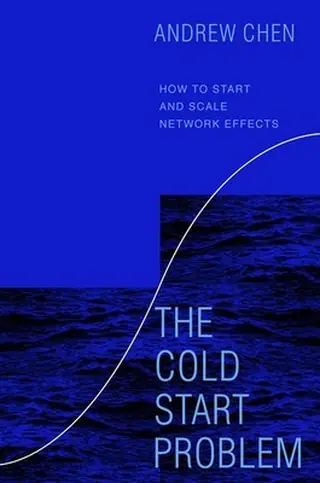
The Cold Start Problem summary
by Andrew Chen · 2021 · 7 key ideas · 15-minute read
How products that get better as more people use them, like marketplaces, social apps and team tools, get started, grow and defend themselves.
Why read it
For anyone building something that connects people: buyers and sellers, hosts and guests, colleagues or friends. Chen gives a stage-by-stage map of network effects, from empty to unstoppable.
The Cold Start Problem in brief
Some products get more valuable the more people use them: a messaging app is useless if none of your friends are on it, and a marketplace is useless without sellers. These are network effects. Chen argues they are the most powerful advantage a tech product can have, but they create a brutal problem at the start: an empty network has no value, so why would anyone join?
He maps the life of a networked product in five stages. The cold start: building the first small network that works. The tipping point: spreading from one network to many. Escape velocity: growth that feeds itself. Hitting the ceiling: problems like spam and saturation that slow growth. And the moat: using network effects to fight competitors.
The key to the cold start is the atomic network, the smallest group that is stable and useful on its own, like one team using a chat tool or one city's drivers and riders. Within it, the hard side, the minority who create most of the value, matters most.
Chen fills the book with examples from companies such as Uber, Slack, Airbnb, Tinder, Wikipedia and Zoom, showing how each solved these problems, often with scrappy, manual tactics at first.
The 7 key ideas
1. Network effects, good and bad
More users can mean more value, or more noise.
2. Start with an atomic network
Win one small network, then copy it.
3. Win the hard side
Look after the hard side; the easy side follows.
4. Come for the tool, stay for the network
Make it worth using alone; make it hard to leave together.
5. Fake it carefully: doing things by hand
Do it by hand until the network can do it itself.
6. Every channel stops working eventually
What works today will work less tomorrow.
7. Networks fight networks
Dense and loyal beats big and loose.
Read the full guide in Kinquire. Every idea with a real example, a diagram and one thing to try today, plus a quick quiz so it sticks. Free to start.
Read The Cold Start ProblemKey takeaways
- Define the smallest group in which your product would be useful on its own.
- Focus early effort on the hard side of your network.
- Make the product valuable for one user before the network exists.
- Be willing to do things by hand to make an early network feel alive.
- Expect growth channels to fade, and keep testing new ones.
- Protect network quality as you grow, not just its size.
Our take
The book offers a clear, memorable framework for a topic that is often discussed vaguely, and its stage-by-stage structure is genuinely useful for founders. Chen draws on deep, firsthand experience in Silicon Valley. The trade-off is that most examples come from very successful, often venture-funded tech companies, which risks survivorship bias: the same tactics may not save a weaker idea. It is also written from an investor's point of view and focuses on growth more than on sustainability or the downsides of large networks for users and workers. For anyone building a marketplace or community product, though, it is one of the most practical guides available.
About Andrew Chen
Andrew Chen is a general partner at the venture capital firm Andreessen Horowitz. He previously led rider growth teams at Uber.
If you liked this
- Zero to One by Peter Thiel with Blake Masters
- 7 Powers by Hamilton Helmer
- Blitzscaling by Reid Hoffman and Chris Yeh
- Hooked by Nir Eyal
- The Lean Startup by Eric Ries
- The Hard Thing About Hard Things by Ben Horowitz