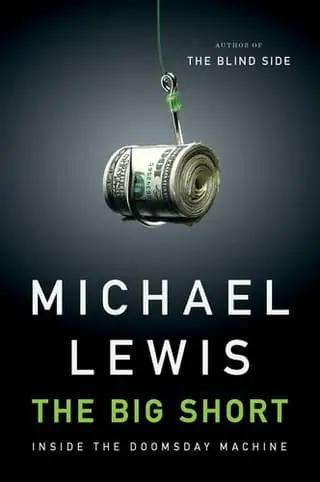
The Big Short summary
by Michael Lewis · 2010 · 7 key ideas · 18-minute read
A handful of misfit investors saw that the US housing market was built on bad loans and broken ratings, bet against it, and watched Wall Street collapse in 2007 and 2008.
Why read it
For anyone who wants to understand the 2008 financial crisis through gripping human stories, and to learn what it takes to see a truth that everyone around you is ignoring.
The Big Short in brief
In the mid-2000s, American lenders were handing out mortgages to people who couldn't afford them. Wall Street bundled these subprime loans into bonds, repackaged the riskiest parts into new securities, and persuaded rating agencies to stamp much of the result as safe as government debt. The whole machine depended on house prices continuing to rise.
Lewis follows the few outsiders who noticed. Michael Burry, a one-eyed former doctor running a small fund in California, read the fine print of mortgage bonds and concluded they would fail. Steve Eisman, an abrasive money manager in New York, saw the fraud in lending firsthand. Two young investors at a tiny firm, Cornwall Capital, spotted that Wall Street was underpricing disaster.
Each found a way to bet against the market, mainly using credit default swaps, a kind of insurance on bonds. For years, their bets looked foolish and cost them money and credibility, while the banks on the other side booked profits. Then, as borrowers defaulted from 2007, the bonds collapsed, the short sellers made fortunes, and major financial institutions failed or had to be rescued.
Lewis ends with a sharp verdict. The crisis wasn't caused by a few bad apples but by a system whose incentives rewarded short-term profits and hid long-term risk. Those who built it largely kept their fortunes, while the costs fell on taxpayers and ordinary homeowners.
The 7 key ideas
1. The doomsday machine
Repackaging risk doesn't remove it.
2. Read what nobody reads
The truth is often in the fine print nobody reads.
3. AAA alchemy
A rating is only as honest as whoever pays for it.
4. Cheap bets on unlikely disasters
When everyone's certain, insurance is cheap.
5. Early looks like wrong
Being right isn't enough. You must survive until it shows.
6. Ground truth beats the model
Go and look. The spreadsheet doesn't.
7. When nobody has skin in the game
Where nobody pays for losses, losses grow.
Read the full guide in Kinquire. Every idea with a real example, a diagram and one thing to try today, plus a quick quiz so it sticks. Free to start.
Read The Big ShortKey takeaways
- Demand a clear explanation of where any investment's returns come from.
- Read source documents yourself rather than relying on summaries or ratings.
- Ask who pays the people who rate, recommend or sell to you.
- Look for cheap protection when everyone else is overconfident.
- Size contrarian bets so you can survive being early.
- Check that decision-makers share the downside of their decisions.
Our take
The Big Short is a brilliant piece of storytelling that makes complex finance understandable through vivid characters. Its explanation of how subprime loans, CDOs and credit default swaps fit together remains one of the clearest available. But it views the crisis mainly through the eyes of a few people who bet against it, which can make it feel like a morality tale with heroes and villains. It covers less of the roles of regulators, central banks and global capital. And its heroes profited from a collapse in which ordinary families lost their homes, which sits a little uneasily with the book's heroic framing.
About Michael Lewis
Michael Lewis is an American writer who worked as a bond salesman at Salomon Brothers before writing Liar's Poker. His other books include Moneyball and Flash Boys.
If you liked this
- The Black Swan by Nassim Nicholas Taleb
- The Psychology of Money by Morgan Housel
- Rich Dad Poor Dad by Robert T. Kiyosaki
- The Intelligent Investor by Benjamin Graham
- I Will Teach You to Be Rich by Ramit Sethi
- The Millionaire Next Door by Thomas J. Stanley and William D. Danko