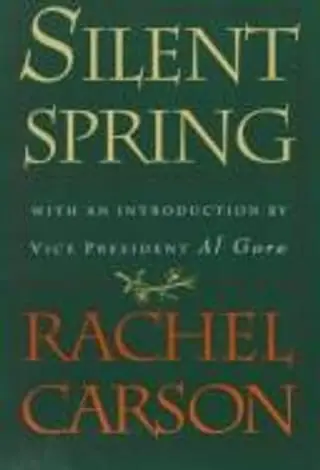
Silent Spring summary
by Rachel Carson · 1962 · 8 key ideas · 21-minute read
A meticulous, lyrical warning that the reckless spraying of synthetic pesticides was poisoning wildlife, water and people — the book that helped launch the modern environmental movement.
Why read it
For anyone who wants to understand how ecosystems are connected, how one book changed public policy, and how to think about technologies whose side effects we don't yet see.
Silent Spring in brief
Carson opens with a fable: an American town where nature once thrived falls silent. Birds vanish, livestock sicken, children fall ill, and a white powder drifts down from the sky. No enemy did this; people did it to themselves. She explains that every disaster in the fable had happened somewhere, though not all in one place.
After the Second World War, new synthetic chemicals such as DDT were sprayed on farms, forests, towns and gardens on a massive scale. Carson explains how they work, why many persist for years, how they accumulate in fat and pass up food chains, and how they ended up in rivers, soil, wildlife and human bodies.
Through case after case — dead robins on a university campus, poisoned salmon rivers, birds killed after aerial campaigns against fire ants — she shows how spraying to kill one pest ripples through entire ecosystems. Often it fails even on its own terms, as insects evolve resistance and pests rebound once their natural enemies are gone.
Carson does not call for banning all pesticides. She argues for restraint, careful targeted use, and better alternatives such as biological controls. Above all, she insists the public has a right to know what is being sprayed on them and to share in decisions that affect the living world. The book provoked fierce industry attacks and lasting policy change.
The 8 key ideas
1. Everything is connected
There's no such thing as only one target.
2. Biocides, not insecticides
Name things for what they actually do.
3. Poisons climb the food chain
Small doses add up on the way to the top.
4. Hidden chains of cause
Follow the poison, not just the spray.
5. Nature fights back
What doesn't kill a pest breeds a stronger pest.
6. We are inside the web
We can't poison the world and stay clean ourselves.
7. There is another road
Outsmart nature's problems; don't just outgun them.
8. The public has a right to know
If you must endure it, you deserve to know it.
Read the full guide in Kinquire. Every idea with a real example, a diagram and one thing to try today, plus a quick quiz so it sticks. Free to start.
Read Silent SpringKey takeaways
- Judge any fix by its effects on the whole system, not just its target.
- Ask what happens to persistent substances over time and up the food chain.
- Avoid overusing chemicals and antibiotics; resistance is the predictable result.
- Prefer targeted solutions over blanket ones wherever possible.
- Ask authorities what's being done in your environment — you have a right to know.
Our take
Silent Spring is a landmark: rigorous for its time, beautifully written, and enormously influential in creating modern environmental policy. Its core insights — persistence, biomagnification, resistance and ecological ripple effects — are now standard science. Some specific claims, particularly on cancer risk, were stronger than the evidence later supported, and its emotive opening made it easy for critics to call it alarmist. Claims that Carson caused malaria deaths are widely regarded by historians as a distortion, since she supported public-health use and warned about resistance. Its lesson about testing before scaling remains urgent.
About Rachel Carson
Rachel Carson (1907–1964) was an American marine biologist who worked for the US Fish and Wildlife Service and wrote bestselling books about the sea, including The Sea Around Us. She died of cancer less than two years after Silent Spring was published.
If you liked this
- Entangled Life by Merlin Sheldrake
- A Brief History of Time by Stephen Hawking
- The Selfish Gene by Richard Dawkins
- Cosmos by Carl Sagan
- A Short History of Nearly Everything by Bill Bryson
- The Gene by Siddhartha Mukherjee