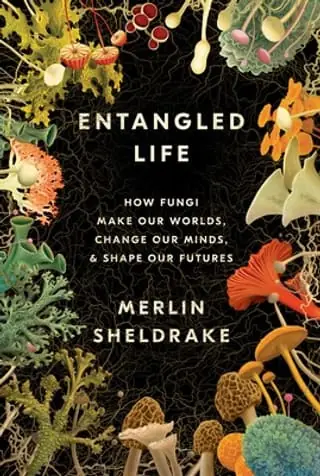
Entangled Life summary
by Merlin Sheldrake · 2020 · 8 key ideas · 20-minute read
Fungi — mostly invisible networks beneath our feet — build soils, feed forests, alter minds and blur the boundaries of what we call an individual.
Why read it
For anyone curious about the hidden living world that underpins ecosystems, food, medicine and even our own thinking, told by a young biologist with a gift for wonder.
Entangled Life in brief
Sheldrake argues that fungi are among the most important and least understood forms of life. We tend to notice only mushrooms, but these are just fruiting bodies. Most of a fungus lives as mycelium, a branching web of fine threads running through soil, wood, bodies and almost every habitat on Earth.
Fungi feed by digesting the world outside their bodies, which makes them master decomposers and recyclers. They also form intimate partnerships. Lichens are fungi joined with algae or bacteria. Most plants rely on fungi in their roots for water and nutrients — a partnership that may have helped plants colonise land in the first place.
The book follows fungi into strange territory: truffles that lure animals with scent, networks that link trees, fungi that hijack the minds of ants, and mushrooms whose compounds can transform human experience. Sheldrake meets truffle hunters, lichen experts, psychedelic researchers and radical mycologists who grow fungi to clean pollution and make materials.
Throughout, he questions our categories. If a lichen is several organisms, what is an individual? If fungi solve problems without brains, what is intelligence? He ends by inviting us to see the living world as a web of relationships — and, in a final experiment, lets fungi eat a copy of his own book.
The 8 key ideas
1. Fungi are mostly hidden
The mushroom is the apple; the mycelium is the tree.
2. The great recyclers
Fungi turn endings into beginnings.
3. Fungi speak in chemicals
No eyes, no ears — just a world of chemistry.
4. Who is an individual?
Every self is a partnership.
5. Plants came ashore with fungi
No fungi, no forests.
6. The wood wide web — with caution
Networks are real; the fairy tales are optional.
7. Fungi can change minds
Minds, too, can be part of a fungal web.
8. Working with fungi
Collaborate with decomposers to build the future.
Read the full guide in Kinquire. Every idea with a real example, a diagram and one thing to try today, plus a quick quiz so it sticks. Free to start.
Read Entangled LifeKey takeaways
- Look beneath the surface: the visible part of a system is often the smallest.
- Value decomposition and recycling — they make renewal possible.
- Think in relationships and partnerships, not just individuals.
- Separate measured findings from appealing narratives in science stories.
- Try partnering with living systems — compost, garden, grow mushrooms.
Our take
Entangled Life is a beautifully written, mind-expanding book that brings an overlooked kingdom into view and links biology to philosophy in fresh ways. Sheldrake is generally careful to flag uncertainty, but his lyrical style and enthusiasm for ideas like fungal 'intelligence' and networks can blur the line between established findings and speculation. The wood wide web, in particular, has faced strong scientific pushback since publication. Some readers also find the meandering structure and frequent questions frustrating. Read it for wonder and perspective, and pair it with sceptical sources on the most popular claims.
About Merlin Sheldrake
Merlin Sheldrake is a British biologist with a PhD in tropical ecology from the University of Cambridge. His doctoral research studied underground fungal networks in the forests of Panama.
If you liked this
- I Contain Multitudes by Ed Yong
- A Brief History of Time by Stephen Hawking
- The Selfish Gene by Richard Dawkins
- Cosmos by Carl Sagan
- A Short History of Nearly Everything by Bill Bryson
- The Gene by Siddhartha Mukherjee