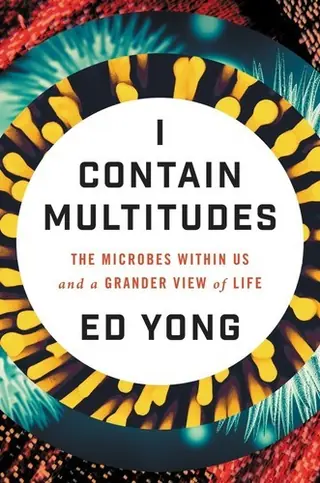
I Contain Multitudes summary
by Ed Yong · 2016 · 8 key ideas · 19-minute read
Every animal, including you, is a walking ecosystem of microbes that shape development, health and behaviour — partners far more than enemies.
Why read it
For anyone curious about the microbiome beyond the headlines: how microbes build bodies, why 'good' and 'bad' bacteria is too simple, and what the science can and can't yet do for your health.
I Contain Multitudes in brief
Yong opens with a visit to a zoo, where he points out that every animal there is itself a zoo, teeming with microbes. Bacteria, fungi and viruses live on and inside all animals. For most of history we saw microbes mainly as germs to be killed. Yong argues that most are harmless or helpful, and many are essential.
He shows how microbes help build animal bodies, train immune systems, digest food, and even provide abilities their hosts could never evolve alone — from insects that live on sap to rodents that eat toxic plants. In many cases, the relationship is so intimate that host and microbe can't survive apart.
But Yong insists that the microbial world isn't divided into heroes and villains. The same microbe can help in one setting and harm in another. Disease often reflects a community out of balance rather than a single invader. He explores how this idea plays out in obesity research, coral reefs, and the immune system.
Finally, he looks at attempts to manipulate microbiomes: faecal transplants, probiotics, designer microbes and the use of a bacterium called Wolbachia to stop mosquitoes spreading disease. He is excited but cautious, warning that the science is young, the hype is large, and our microbial partners are complex.
The 8 key ideas
1. Every animal is a zoo
You are not one; you are many.
2. Microbes help build bodies
Bodies are built by teams, not soloists.
3. No good or bad microbes
It's not who they are — it's where and when.
4. Disease as an ecosystem out of balance
Sometimes the problem is the whole crowd, not one stranger.
5. Microbes grant superpowers
Can't evolve it? Borrow it.
6. Feeding our partners
When you eat, you feed a crowd.
7. Rebuilding microbiomes — carefully
Ecosystems aren't fixed with a pill.
8. Microbes against disease
Fight microbes with microbes.
Read the full guide in Kinquire. Every idea with a real example, a diagram and one thing to try today, plus a quick quiz so it sticks. Free to start.
Read I Contain MultitudesKey takeaways
- Think of your body as an ecosystem, not a fortress.
- Avoid unnecessary antibiotics and harsh antimicrobial products.
- Eat more fibre-rich plants to feed beneficial microbes.
- Be sceptical of probiotic claims without strain-specific evidence.
- Replace 'good vs bad microbes' with 'right context, right balance'.
Our take
I Contain Multitudes is one of the best introductions to the microbiome: engaging, carefully reported and refreshingly sceptical of hype. Yong consistently distinguishes animal studies from human evidence and correlation from causation. Its limits come from the field itself: much microbiome science is early, many mouse findings haven't translated to people, and practical advice is thin. Some specifics have moved on, including approved microbial treatments and Wolbachia trial results. Readers seeking a diet plan will be disappointed; readers wanting a new way to see biology will be delighted.
About Ed Yong
Ed Yong is a British science journalist who later won the 2021 Pulitzer Prize for Explanatory Reporting for his COVID-19 coverage at The Atlantic. This was his first book.
If you liked this
- An Immense World by Ed Yong
- Entangled Life by Merlin Sheldrake
- The Gene by Siddhartha Mukherjee
- A Brief History of Time by Stephen Hawking
- The Selfish Gene by Richard Dawkins
- Cosmos by Carl Sagan