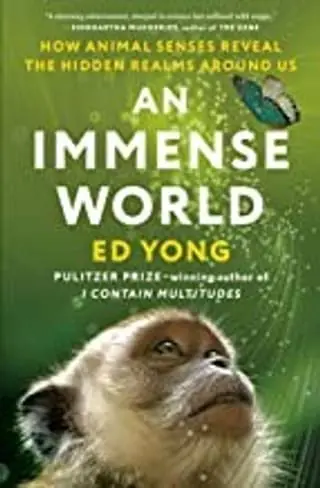
An Immense World summary
by Ed Yong · 2022 · 8 key ideas · 21-minute read
Every animal lives inside its own sensory bubble, and exploring how others smell, see, hear and feel reveals a world far richer than the one we perceive.
Why read it
For anyone who loves animals or wants to see the world afresh: a tour of senses from echolocation to electric fields, and a reminder of how much we miss — and how we may be harming what we can't sense.
An Immense World in brief
Yong builds the book on a concept from the early twentieth-century biologist Jakob von Uexküll: the Umwelt, the sensory world unique to each species. A tick, a bat, a bee and a human can stand in the same garden yet live in completely different worlds, because each senses only the slice of reality relevant to its life.
Chapter by chapter, he explores the senses: smell and taste, vision and colour, pain, heat, touch and flow, vibrations through surfaces, sound, echolocation, electric fields and magnetic fields. In each, he meets researchers studying creatures whose abilities sound like science fiction, from dogs reading the world by scent to bumblebees sensing the electric charge of flowers.
Along the way he insists we resist ranking animals by how impressive their senses are compared to ours. Each Umwelt is shaped by an animal's needs, and every sense comes with trade-offs. The goal is not to find superpowers but to imagine, with humility, how other creatures experience their lives.
Yong ends with a warning. Humans have flooded the world with artificial light and noise, creating sensory pollution that disorients and harms animals. Just as we can't see ultraviolet or hear ultrasound, we often fail to notice the damage. He urges us to save the quiet and preserve the dark.
The 8 key ideas
1. Every creature has its own bubble
Your world is one bubble among millions.
2. Don't rank the senses
Ask what a sense is for, not how good it is.
3. Colours beyond imagination
More receptors don't mean more colour.
4. Pain is not just a reflex
Reacting to harm isn't the same as feeling it — but it might be.
5. The world is full of hidden messages
Silence to us can be a conversation to them.
6. Senses we don't have
Some animals see with sound and touch with electricity.
7. Some mysteries remain
'We don't know yet' is an honest scientific answer.
8. Save the quiet, preserve the dark
What we can't sense, we must choose to protect.
Read the full guide in Kinquire. Every idea with a real example, a diagram and one thing to try today, plus a quick quiz so it sticks. Free to start.
Read An Immense WorldKey takeaways
- Remember that your perception is one limited Umwelt among many.
- Ask what a sense is for, rather than ranking animals against humans.
- Slow down and let dogs (and yourself) explore through other senses.
- Accept 'we don't know yet' as an honest answer in science.
- Reduce unnecessary light and noise — they pollute other animals' worlds.
Our take
An Immense World is a richly reported, beautifully written book that genuinely expands how you see the world, and Yong is careful about scientific uncertainty, flagging debates and failed replications. Its structure — one sense per chapter — can feel encyclopaedic, and it focuses more on describing senses than on explaining how they evolved. Some topics, such as fish and insect pain or magnetoreception, remain contested, and his conclusions there are necessarily provisional. The closing call to tackle sensory pollution is persuasive but brief. Overall, it's a model of humble, wonder-filled science writing.
About Ed Yong
Ed Yong is a British science journalist who was a staff writer at The Atlantic, where his coverage of the COVID-19 pandemic won the 2021 Pulitzer Prize for Explanatory Reporting. His first book was I Contain Multitudes.
If you liked this
- I Contain Multitudes by Ed Yong
- Entangled Life by Merlin Sheldrake
- A Brief History of Time by Stephen Hawking
- The Selfish Gene by Richard Dawkins
- Cosmos by Carl Sagan
- A Short History of Nearly Everything by Bill Bryson