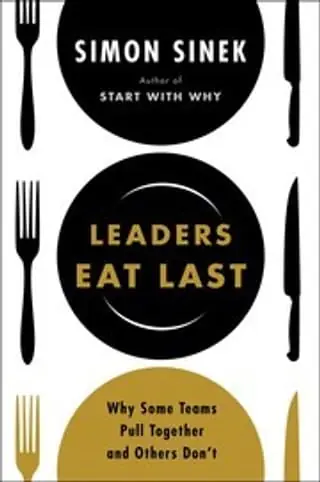
Leaders Eat Last summary
by Simon Sinek · 2014 · 7 key ideas · 19-minute read
Great teams form when leaders make people feel safe inside the group — by putting their people's interests before their own.
Why read it
For managers and anyone who wants to understand why some workplaces feel like a team and others like a battlefield. It explains trust and loyalty through biology, stories and the choices leaders make under pressure.
Leaders Eat Last in brief
The title comes from a tradition Sinek learned about in the US Marine Corps: in the chow line, the most junior Marines eat first and the senior officers eat last. It isn't a rule anyone enforces; it reflects an expectation that leaders put the needs of those in their care before their own.
Sinek's core idea is the Circle of Safety. Outside every organisation there are dangers — competitors, the economy, change — that we can't control. Inside, leaders decide whether people feel safe or threatened. When people trust that their leaders and colleagues have their backs, they stop spending energy protecting themselves and turn it toward the outside challenges together.
He explains this with a simple tour of brain chemistry: endorphins and dopamine drive individual achievement, serotonin and oxytocin drive social bonds and trust, and cortisol is the stress chemical that floods us when we feel unsafe. Workplaces that reward only numbers, he argues, run on dopamine and cortisol.
Sinek then criticises modern business for treating people as numbers — layoffs to hit quarterly targets, leaders distant from the human effects of their decisions — and tells stories of leaders who chose people over short-term figures. Leadership, he concludes, is not a rank but a choice to look after others, and it is built through small, consistent acts over time.
The 7 key ideas
1. The Circle of Safety
Feel safe inside, and you'll fight together outside.
2. Leaders eat last
Leadership's privileges come with a bill — pay it.
3. Four chemicals, two jobs
Targets give a buzz; trust gives a team.
4. Stress comes from lack of control
Pressure with support is a challenge; without it, a threat.
5. Abstraction makes us cruel
Numbers don't feel pain — people do.
6. Share the pain, keep the people
Better we all suffer a little than a few suffer a lot.
7. Leadership is a daily practice
Trust is a habit, not an event.
Read the full guide in Kinquire. Every idea with a real example, a diagram and one thing to try today, plus a quick quiz so it sticks. Free to start.
Read Leaders Eat LastKey takeaways
- Thank people for bringing bad news before you react to it.
- Give up one leadership perk visibly and regularly.
- Balance number-based rewards with recognition for helping others.
- Meet the people affected by a decision before you make it.
- Practise small, daily acts of care rather than occasional big gestures.
Our take
Leaders Eat Last puts a powerful, humane idea at the centre of management: people perform best when they feel safe and cared for, and leaders shape that more than anyone. The stories are moving and the Circle of Safety aligns with solid research on psychological safety. The weaker parts are the simplified neurochemistry, which experts would challenge, and a long late section blaming the ‘Baby Boomer’ generation and ‘destructive abundance’ that reads as opinion rather than evidence. Some readers also find the book repetitive. Its core message has held up well.
About Simon Sinek
Simon Sinek is the author of Start with Why and a speaker known for his talks on leadership and purpose. He is also known for the idea that leadership is a choice, not a rank.
If you liked this
- Start with Why by Simon Sinek
- The Culture Code by Daniel Coyle
- Extreme Ownership by Jocko Willink and Leif Babin
- Good to Great by Jim Collins
- Built to Last by Jim Collins and Jerry I. Porras
- The Innovator's Dilemma by Clayton M. Christensen