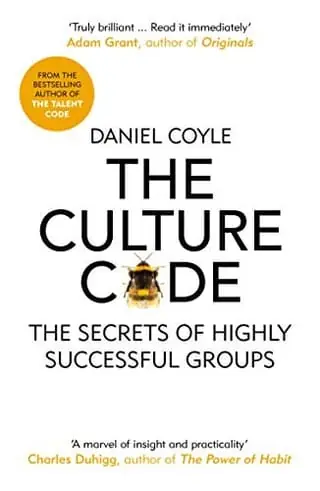
The Culture Code summary
by Daniel Coyle · 2018 · 7 key ideas · 17-minute read
Great group cultures aren't magic — they're built from three learnable skills: making people feel safe, sharing vulnerability, and establishing a clear purpose.
Why read it
For leaders, coaches, teachers and anyone who wants a group to perform better together. It's full of vivid stories from sports teams, special forces, restaurants and tech companies, and ends each section with practical ideas.
The Culture Code in brief
Coyle set out to learn why some groups add up to more than the sum of their parts while others add up to less. He visited and studied successful groups — including the San Antonio Spurs basketball team, US Navy SEAL teams, Pixar, a famous restaurant group and a comedy troupe — and looked for common patterns.
He found that strong cultures are driven not by who's in them but by how people interact, and that this comes down to three skills. Build Safety: send constant signals that people belong and are valued. Share Vulnerability: create habits of admitting mistakes and asking for help so people can cooperate deeply. Establish Purpose: tell clear, repeated stories about what the group is for and how it behaves.
Each skill gets a section of stories followed by practical ideas. Many of the signals Coyle describes are small — eye contact, listening carefully, thanking people, the way feedback is delivered — but repeated constantly, they shape whether people feel safe enough to contribute.
Coyle's message is optimistic: culture isn't a fixed personality that a company either has or lacks. It's a set of behaviours that anyone in a group, and especially its leader, can learn, practise and improve — one interaction, one signal and one story at a time.
The 7 key ideas
1. Belonging beats brilliance
Stop managing status; start building together.
2. Belonging cues
Belonging is built in small signals, sent constantly.
3. One bad apple — and one antidote
One person can poison a team — or protect it.
4. Vulnerability builds cooperation
Trust comes after vulnerability, not before.
5. Listen like a trampoline
Don't add value too soon — add lift.
6. Feedback that signals belonging
High standards plus belief makes criticism feel like care.
7. Make purpose unmissable
Say what matters, rank it, repeat it.
Read the full guide in Kinquire. Every idea with a real example, a diagram and one thing to try today, plus a quick quiz so it sticks. Free to start.
Read The Culture CodeKey takeaways
- Send small, constant signals of belonging — eye contact, attention, thanks.
- Make sure everyone speaks early in meetings.
- Admit your own mistakes first, especially as a leader.
- Ask questions before offering advice when someone shares a problem.
- Pair tough feedback with high standards and belief in the person.
- Rank your team's priorities and repeat them often.
Our take
The Culture Code is engaging and practical, packed with memorable stories and concrete suggestions. It brings together a lot of research on belonging, trust and group performance in an accessible way. Its weaknesses are typical of popular business books: the stories are drawn from already-successful groups, which risks survivorship bias, and some studies are small or presented with more certainty than the evidence supports. The three-part model is simple and overlaps heavily with existing work on psychological safety. Still, as a guide to the everyday behaviours that shape how a group works, it's useful and widely recommended.
About Daniel Coyle
Daniel Coyle is an American journalist and author, also known for The Talent Code, a book about how skill is developed. He has written extensively about sport and high performance.
If you liked this
- Leaders Eat Last by Simon Sinek
- Creativity, Inc. by Ed Catmull with Amy Wallace
- Good to Great by Jim Collins
- Built to Last by Jim Collins and Jerry I. Porras
- The Innovator's Dilemma by Clayton M. Christensen
- Blue Ocean Strategy by W. Chan Kim and Renée Mauborgne