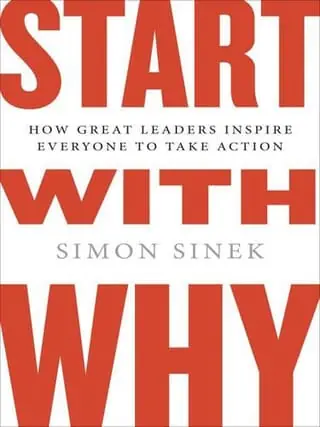
Start with Why summary
by Simon Sinek · 2009 · 7 key ideas · 18-minute read
People don't buy what you do, they buy why you do it — so leaders and organisations that communicate their purpose first inspire lasting loyalty.
Why read it
For founders, managers and anyone trying to rally people around an idea. It gives you a simple model — the Golden Circle — for explaining what you stand for and testing whether your actions match it.
Start with Why in brief
Sinek starts with a puzzle: why do some organisations and leaders inspire extraordinary loyalty while equally capable rivals don't? His answer is that most organisations communicate from the outside in — what they make, then how it's better — while the inspiring ones start from the inside: why they exist.
He draws this as the Golden Circle: three rings with Why at the centre, How in the middle and What on the outside. Apple, the Wright brothers and Martin Luther King Jr. are his recurring examples of people who led with a belief, which drew others who shared it.
Sinek contrasts inspiration with manipulation. Price cuts, promotions, fear, aspiration, peer pressure and novelty can all drive a sale, but they don't build loyalty and must be paid for again and again. Purpose builds trust, which is what makes people stick with you when a cheaper option appears.
To lead with Why, an organisation needs clarity of Why, discipline of How and consistency of What. The danger comes as organisations grow: founders leave, the Why gets fuzzy, and companies drift toward chasing results. Sinek calls this the ‘split’ — and argues that the cure is to rediscover and live out the original purpose.
The 7 key ideas
1. The Golden Circle
People don't buy what you do; they buy why you do it.
2. Inspire, don't manipulate
Manipulation buys a sale; inspiration earns a follower.
3. The biology of ‘gut feel’
We decide with feelings and defend with facts.
4. Win the early adopters first
Win the believers; they'll win the rest.
5. Clarity, discipline, consistency
Everything you do should prove what you believe.
6. When the Why goes fuzzy
Growth without why turns a cause into a company.
7. Leaders hire for belief
Hire the believers; train the skills.
Read the full guide in Kinquire. Every idea with a real example, a diagram and one thing to try today, plus a quick quiz so it sticks. Free to start.
Read Start with WhyKey takeaways
- Write a one-sentence Why for yourself, your team or your business — without mentioning products or profit.
- Open your next pitch with why it matters before listing any features.
- Notice when promotions and pressure have replaced purpose, and rebalance.
- Check recent decisions against your Why and fix the ones that contradict it.
- Hire and recruit by stating what you believe, not just what the job involves.
Our take
Start with Why gives people a memorable, genuinely useful tool: forcing yourself to state your purpose clarifies decisions and messaging. Its weaknesses are well known. The brain science is oversimplified and partly outdated, and the evidence is mostly hand-picked success stories explained in hindsight — classic survivorship bias. Many companies with sincere missions still fail on execution, price or timing, which the model underplays. And ‘purpose’ can become a marketing veneer. Read it as a communication and alignment framework, not a proven theory of why businesses win.
About Simon Sinek
Simon Sinek is a British-born American author and speaker. His 2009 TED talk on the Golden Circle, ‘How great leaders inspire action’, became one of the most-watched TED talks of all time.
If you liked this
- Leaders Eat Last by Simon Sinek
- Built to Last by Jim Collins and Jerry I. Porras
- Thinking, Fast and Slow by Daniel Kahneman
- Good to Great by Jim Collins
- The Innovator's Dilemma by Clayton M. Christensen
- Blue Ocean Strategy by W. Chan Kim and Renée Mauborgne