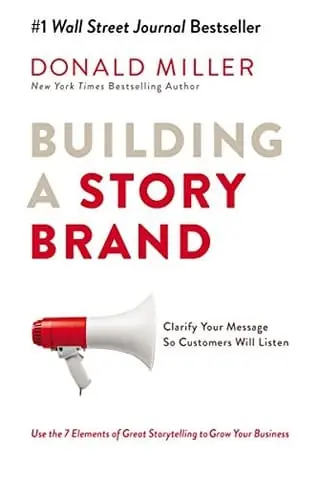
Building a StoryBrand summary
by Donald Miller · 2017 · 7 key ideas · 17-minute read
Stop making your brand the hero: cast your customer as the hero of a simple story, position yourself as their guide, and your marketing becomes clear enough to work.
Why read it
For small business owners, nonprofits and marketers whose websites and pitches feel cluttered. It offers a concrete seven-part framework for writing messages customers instantly understand.
Building a StoryBrand in brief
Donald Miller's diagnosis is that most businesses don't fail because of bad products. They fail because their message is confusing. Websites full of jargon, clever slogans and company history make customers work too hard, and the human brain, constantly trying to save energy, simply tunes them out. His motto: if you confuse, you lose.
His fix borrows from storytelling. Nearly every good story follows a pattern: a character wants something, runs into a problem, meets a guide who gives them a plan and calls them to action, and the story ends either in success or in failure. Miller calls this the SB7 Framework.
The crucial move is in casting. Your brand is not the hero — your customer is. Brands that position themselves as the hero compete with their customers for the spotlight. Brands that act as the guide, showing empathy and authority, earn trust. They define the customer's external, internal and philosophical problems, offer a simple plan, ask clearly for action, and paint a vivid picture of the stakes.
Miller turns this into a practical tool, the BrandScript, and shows how to apply it to websites, emails and sales pitches. The aim is a message so clear that someone glancing at your homepage for a few seconds understands what you offer, how it will improve their life and how to get it.
The 7 key ideas
1. If you confuse, you lose
Clarity beats clever.
2. Your customer is the hero
They're Luke. You're Yoda.
3. Sell to the internal problem
Fix the thing. Name the feeling.
4. Be the guide: empathy plus authority
Show you care, then show you can.
5. Give them a simple plan
Three steps make a scary decision small.
6. Call them to action — clearly
If you don't ask, they won't act.
7. Show the stakes and the transformation
Show what's lost, what's won and who they become.
Read the full guide in Kinquire. Every idea with a real example, a diagram and one thing to try today, plus a quick quiz so it sticks. Free to start.
Read Building a StoryBrandKey takeaways
- Cast your customer as the hero and your brand as the guide.
- Name the external, internal and philosophical problem you solve.
- Show empathy and authority near the top of every page.
- Give a three-step plan and a promise that eases the biggest fear.
- Use one clear direct call to action plus a transitional offer.
- Paint the stakes lightly and the success vividly.
Our take
Building a StoryBrand is one of the most usable marketing books for small organisations: its framework is concrete, easy to teach and genuinely improves cluttered websites and pitches. Its limits are equally clear. The framework can produce formulaic marketing — many sites using it look and sound alike — and the neuroscience behind “survive and thrive” is simplified. It says little about strategy, positioning against competitors or pricing; it assumes you already know who your customer is. Use it as a messaging tool, alongside positioning work like Obviously Awesome.
About Donald Miller
Donald Miller is the founder of the StoryBrand marketing consultancy and was a bestselling memoirist before that, best known for Blue Like Jazz. He later wrote Marketing Made Simple and other business books.
If you liked this
- Made to Stick by Chip Heath and Dan Heath
- Obviously Awesome by April Dunford
- Zero to One by Peter Thiel with Blake Masters
- The Lean Startup by Eric Ries
- The Hard Thing About Hard Things by Ben Horowitz
- The E-Myth Revisited by Michael E. Gerber