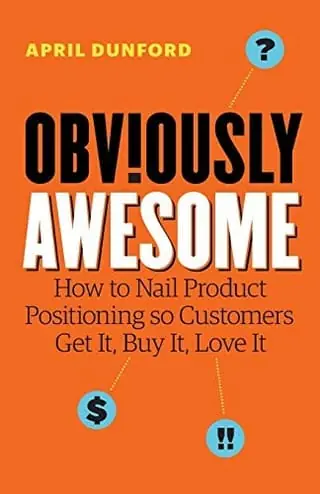
Obviously Awesome summary
by April Dunford · 2019 · 7 key ideas · 16-minute read
Great products fail when customers can't see why they matter; positioning gives them the context, and you can design it step by step instead of leaving it to accident.
Why read it
For founders, product marketers and sales teams — especially in tech — whose product is good but keeps being misunderstood, compared with the wrong rivals or sold on price.
Obviously Awesome in brief
April Dunford starts with a puzzle familiar to many founders: the product is good, early customers love it, yet most prospects don't get it. They compare it to the wrong alternatives, can't see why it's different, and push on price. Her diagnosis is weak positioning — and most companies never deliberately chose theirs at all.
Positioning, she argues, is context-setting. Customers can't judge a product in isolation; they need a frame of reference. Change the frame and the same product can look obviously awesome or obviously flawed. Positioning defines how your product is the best in the world at delivering value that a well-defined set of customers cares a lot about.
Dunford breaks positioning into five components: competitive alternatives (what customers would do if you didn't exist), unique attributes, the value those attributes enable, the customers who care a lot about that value, and the market category that makes it all obvious. Relevant trends can be layered on top, carefully.
She turns this into a practical ten-step process run by a cross-functional team, starting from the customers who love you most. The result is a positioning the whole company can use in marketing, sales and product decisions — and revisit as markets change.
The 7 key ideas
1. Positioning is context
Change the frame, change the value.
2. Your positioning is probably an accident
If you didn't choose your position, the market chose it for you.
3. The five components of positioning
Alternatives, attributes, value, who cares, category — in that order.
4. Know your real competition
Your real rival is what they'd do without you.
5. From features to value
Features tell. Value sells. Proof convinces.
6. Target the people who care a lot
Not everyone. The ones who care a lot.
7. Choose a market frame that makes you win
Pick the pond where you're the big fish.
Read the full guide in Kinquire. Every idea with a real example, a diagram and one thing to try today, plus a quick quiz so it sticks. Free to start.
Read Obviously AwesomeKey takeaways
- Find out what prospects actually compare you with.
- Start positioning from your happiest, best-fit customers.
- List true competitive alternatives, including doing nothing.
- Translate unique attributes into value and back it with proof.
- Describe your target customer in observable traits.
- Choose the market category where your strengths are obvious.
Our take
Obviously Awesome is one of the most practical books on positioning: clear definitions, a step-by-step process and plenty of hard-won advice from the trenches of tech start-ups. Its focus is also its limit. Examples and language lean heavily toward B2B software, so consumer brands and non-tech businesses must translate. It says less about brand-building, creative execution and long-term memory effects, which researchers like Byron Sharp stress. And the process works best with access to real customers and a willing leadership team. Within those bounds, it's an excellent working manual.
About April Dunford
April Dunford spent many years as a marketing executive at technology startups before becoming a positioning consultant. She later wrote Sales Pitch, a follow-up on turning positioning into sales conversations.
If you liked this
- Positioning by Al Ries and Jack Trout
- Crossing the Chasm by Geoffrey A. Moore
- This Is Marketing by Seth Godin
- Zero to One by Peter Thiel with Blake Masters
- The Lean Startup by Eric Ries
- The Hard Thing About Hard Things by Ben Horowitz