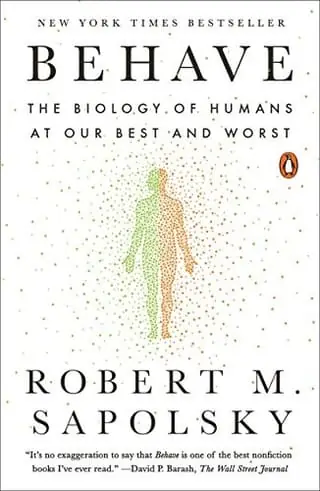
Behave summary
by Robert M. Sapolsky · 2017 · 8 key ideas · 20-minute read
To understand any human act, from cruelty to kindness, you must look back a second, a day, a decade, a lifetime and millions of years, because biology and context are woven together at every scale.
Why read it
For anyone who wants a deep, honest account of why people do what they do. It's long and demanding, but it changes how you think about blame, bias and human nature.
Behave in brief
Sapolsky sets out to explain human behaviour at its best and worst: violence, aggression, competition, but also cooperation, empathy and altruism. His method is to take a single act, such as pulling a trigger or touching an arm, and ask what caused it, stepping further and further back in time.
One second before, he looks at the nervous system: the amygdala, the frontal cortex and other regions. Seconds to minutes before, at the sights, sounds and smells that triggered it. Hours to days before, at hormones like testosterone and oxytocin. Then months before (brain plasticity), adolescence, childhood, the womb, genes, culture and, finally, evolution.
At every level, he shows that biology rarely determines behaviour on its own. Hormones amplify tendencies rather than create them; genes matter in interaction with environments; and the same brain machinery can produce love or hatred depending on context. His refrain, in effect, is that it's complicated, and that simple single-cause stories are almost always wrong.
The second half applies this toolkit to big questions: why we divide the world into Us and Them, how hierarchy and status shape behaviour, where morality comes from, how empathy works and fails, and when war and peace become likely.
Sapolsky ends with his most provocative argument: that the more we understand the biology of behaviour, the less room there is for free will in the traditional sense. He suggests this should change how we think about blame and criminal justice, shifting the focus from punishment toward protecting society and understanding causes.
The 8 key ideas
1. Ask 'why' across every timescale
One act, many causes, every timescale.
2. The frontal cortex does the harder thing
Self-control runs on fuel. Don't decide on empty.
3. Hormones amplify, they don't dictate
Hormones turn up the volume. Context picks the song.
4. Oxytocin is for us, not them
The glue that binds us can also divide us.
5. The adolescent brain is unfinished
Accelerator early, brakes late.
6. Us vs Them is automatic but flexible
The line between Us and Them is drawn, not fixed.
7. Genes and environment can't be separated
Not nature or nurture: nature through nurture.
8. Rethink blame
Understand causes before assigning blame.
Read the full guide in Kinquire. Every idea with a real example, a diagram and one thing to try today, plus a quick quiz so it sticks. Free to start.
Read BehaveKey takeaways
- Look for causes at several timescales before explaining any behaviour.
- Make important decisions when you're rested, fed and calm.
- Shape group cultures so status is earned through good behaviour.
- Extend trust deliberately beyond your in-group.
- Be patient with adolescents, especially around peer pressure.
- Ask what shaped someone's behaviour before deciding how much to blame them.
Our take
Behave is a monumental achievement: funny, humane and astonishingly broad, it gives readers a toolkit for thinking about behaviour that resists simple answers. Its weaknesses come with its ambition. At more than 700 pages it's long and demanding, and some research it draws on, especially on hormones, priming-style effects and candidate genes, has since been questioned. Sapolsky usually flags uncertainty, but the sheer volume of studies makes it hard for readers to tell solid findings from shaky ones. His argument against free will is bold and not shared by most philosophers. Even so, its central lesson, that behaviour has many interacting causes, is robust.
About Robert M. Sapolsky
Robert Sapolsky is a professor of biology and neurology at Stanford University. He spent many years studying wild baboons in Kenya and also wrote Why Zebras Don't Get Ulcers and A Primate's Memoir.
If you liked this
- The Righteous Mind by Jonathan Haidt
- Thinking, Fast and Slow by Daniel Kahneman
- Predictably Irrational by Dan Ariely
- The Happiness Hypothesis by Jonathan Haidt
- Flow by Mihaly Csikszentmihalyi
- Emotional Intelligence by Daniel Goleman