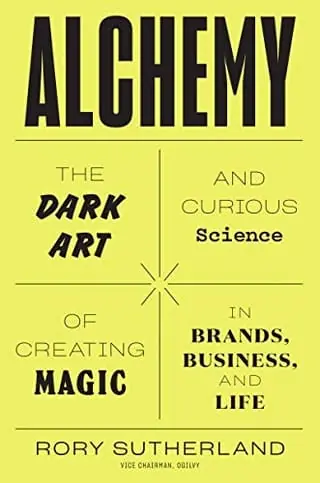
Alchemy summary
by Rory Sutherland · 2019 · 7 key ideas · 18-minute read
Humans run on psycho-logic, not logic — so the most valuable solutions often change how something feels rather than how it works, and look absurd to a spreadsheet.
Why read it
For marketers, product designers, policymakers and anyone frustrated that “rational” plans keep failing. It's a funny, idea-packed invitation to test what seems silly.
Alchemy in brief
Rory Sutherland, a veteran advertising executive, argues that we've become too attached to logic. Economists, engineers and consultants assume people behave rationally, so they look for solutions that make sense on paper. But human beings run on what he calls psycho-logic: a set of instincts, shortcuts and emotional needs shaped by evolution, which often makes perfect sense once you understand it.
This creates a huge opportunity. Because everyone else is busy being logical, the cheap, counterintuitive solutions are left lying around. Changing how something is perceived — its name, its framing, its context — can be worth far more than changing the thing itself, and for a fraction of the cost.
Sutherland ranges across signalling (why costly, seemingly wasteful gestures build trust), the way attention shapes experience, placebos and reframing, and satisficing (why people seek good-enough options that avoid disaster, rather than the theoretical best). Examples range from Red Bull and Uber to Frederick the Great's campaign to make Prussians eat potatoes.
His conclusion is not that logic is bad, but that it's incomplete. The best problem-solvers combine rigour with curiosity about why people really do things — and are willing to test ideas that look silly, because nobody else will. In a world of identical spreadsheets, a little magic is a competitive advantage.
The 7 key ideas
1. Psycho-logic beats logic
People aren't irrational. They're psycho-logical.
2. The opposite of a good idea
If everyone's being logical, try the opposite.
3. Change the perception, not the product
Don't make it shorter. Make it better to wait.
4. Reduce uncertainty, not just waiting
It's not the wait. It's the not knowing.
5. Costly signals build trust
Effort is the message.
6. Reframe to change behaviour
Don't force it. Make it desirable.
7. Satisficing: avoid disaster first
People buy the option least likely to go wrong.
Read the full guide in Kinquire. Every idea with a real example, a diagram and one thing to try today, plus a quick quiz so it sticks. Free to start.
Read AlchemyKey takeaways
- Before improving a product, ask how you could improve how it feels.
- Reduce uncertainty with information, not just speed.
- Use costly, sincere signals to build trust.
- Lower perceived risk with guarantees and familiarity.
- Run small tests of counterintuitive ideas nobody else will try.
Our take
Alchemy is witty, original and full of ideas that make you look at familiar problems differently; its core message — that perception and psychology are undervalued levers — is valuable and often neglected. Its limits come from its style. It's built on anecdotes and thought experiments rather than systematic evidence, and some stories, like Frederick the Great's potatoes, are closer to legend than history. Parts of the behavioural science it draws on have had replication problems. It's also loosely organised. Best read as a provocation to test unusual ideas, not as proof that they'll work.
About Rory Sutherland
Rory Sutherland is vice chairman of the advertising agency Ogilvy in the UK, where he helped set up a behavioural science practice. He has also written a long-running column for The Spectator.
If you liked this
- Thinking, Fast and Slow by Daniel Kahneman
- Nudge by Richard H. Thaler and Cass R. Sunstein
- Influence by Robert B. Cialdini
- Predictably Irrational by Dan Ariely
- Zero to One by Peter Thiel with Blake Masters
- The Lean Startup by Eric Ries