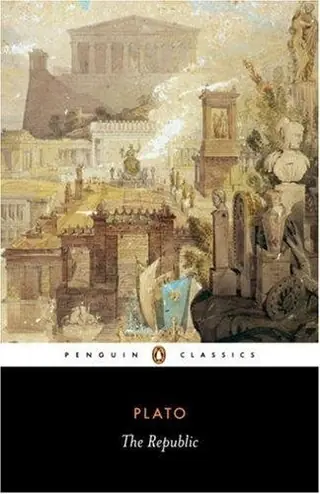
The Republic summary
by Plato · -375 · 7 key ideas · 20-minute read
A long conversation about what justice is and why it's worth having, which builds an ideal city to answer the question and ends up shaping Western philosophy.
Why read it
For anyone curious where many of our biggest ideas about justice, education, leadership and reality began. Its images, like the Cave and the Ring of Gyges, are still some of the best thinking tools ever invented.
The Republic in brief
The Republic is a dialogue, narrated by Socrates, that begins with a simple question at a gathering in a friend's house near Athens: what is justice? Early answers fail under questioning, and the aggressive Thrasymachus claims justice is just whatever benefits the stronger. Plato's brothers Glaucon and Adeimantus then sharpen the challenge: prove that being just is better than merely appearing just, even if no one would ever find out.
To answer, Socrates suggests looking at justice on a larger scale, in a city, and then applying the lesson to the individual soul. He builds an imaginary ideal city in which each class does its proper job, ruled by philosophers trained to know what is truly good. Justice in the city turns out to be each part doing its own work. In the soul, it is reason, spirit and appetite each playing their proper role in harmony.
This leads into the book's most famous passages: the claim that philosophers should rule, the images of the Sun and the Divided Line, and the Allegory of the Cave, which pictures most people as prisoners mistaking shadows for reality. Education, for Plato, is the turning of the soul toward the light.
Later books trace how cities and souls decay, from the ideal through rule by honour, wealth and freedom down to tyranny, and argue that the tyrant is the most miserable person of all. The work ends by criticising poetry and with a myth about the afterlife. Its conclusion: justice is a kind of health of the soul, worth having for its own sake.
The 7 key ideas
1. The ring of invisibility
Character is what you do with the ring on.
2. Your soul has three parts
Reason holds the reins; spirit pulls with it; appetite follows.
3. Each to their own work
Justice is everyone doing their own job well.
4. Leaving the cave
Learning hurts the eyes before it opens them.
5. Philosophers should rule
Give the helm to the navigator, not the loudest sailor.
6. How good systems decay
Every virtue pushed to excess plants the seed of the next decline.
7. The tyrant is the least free
Unlimited power over others; no power over yourself.
Read the full guide in Kinquire. Every idea with a real example, a diagram and one thing to try today, plus a quick quiz so it sticks. Free to start.
Read The RepublicKey takeaways
- Ask whether you'd act the same if no one could ever see.
- When torn, let reason decide and recruit your pride to support it.
- Put people, including yourself, in roles that suit their strengths.
- Seek out views that challenge your assumptions, even when uncomfortable.
- Prefer leaders chosen for wisdom and integrity over persuasiveness.
- Watch for virtues being pushed to self-destructive extremes.
Our take
The Republic is foundational: its questions about justice, its psychology of inner conflict and images like the Cave remain central to philosophy and education. Its ideal city, however, is deeply troubling to modern readers. It relies on censorship of art, a “noble lie” told to citizens about their origins, rigid class divisions and the abolition of family life for the ruling class. Popper famously saw it as a blueprint for totalitarianism. At the same time, Plato argued that women could be guardians alongside men, radical for his era. Many scholars also debate how literally Plato meant the city. Translations vary in style, and the dialogue form means reading it is part of the point.
About Plato
Plato was an Athenian philosopher, a student of Socrates and the teacher of Aristotle. He founded the Academy in Athens and wrote his philosophy as dialogues, usually with Socrates as the main speaker.
If you liked this
- Nicomachean Ethics by Aristotle
- Justice: What's the Right Thing to Do? by Michael J. Sandel
- The Consolations of Philosophy by Alain de Botton
- Meditations by Marcus Aurelius
- Letters from a Stoic by Seneca
- The Enchiridion by Epictetus