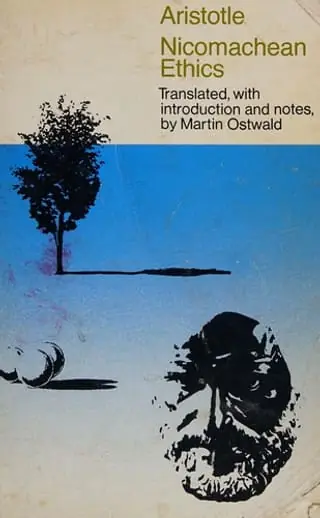
Nicomachean Ethics summary
by Aristotle · -340 · 8 key ideas · 21-minute read
A practical inquiry into how to live well, arguing that happiness comes from developing good character through habit and living it out over a whole life.
Why read it
For anyone who wants a grown-up, realistic account of what a good life is. Aristotle's ideas on habit, balance, practical judgment and friendship underpin much of modern thinking about character and wellbeing.
Nicomachean Ethics in brief
Aristotle starts from a simple observation: everything we do aims at some good, and the ultimate good, the one we want for its own sake, is eudaimonia, usually translated as happiness or flourishing. Not a passing feeling, but living well and doing well over a whole life.
What does that consist of? Aristotle argues that the good for any being depends on its characteristic activity. A good knife cuts well; a good human lives well according to reason. So human flourishing is activity in line with virtue, or excellence, sustained across a lifetime and supported by enough external goods like health, friends and resources.
Most of the book explores the virtues. Moral virtues like courage, generosity and honesty are not inborn; we acquire them by practice, just as we learn a craft. Each is a mean between two extremes, one of excess and one of deficiency, found not by formula but by practical wisdom, the experienced judgment to see what a situation calls for.
Aristotle also examines weakness of will, the nature of pleasure and, at length, friendship, which he considers essential to a good life. He ends by arguing that the highest happiness lies in contemplation, the activity of understanding, though a fully human life combines this with practical virtue in a community.
The 8 key ideas
1. Happiness is the final goal
Know the final target, then aim everything at it.
2. One swallow doesn't make a spring
One swallow doesn't make a spring. Judge the season, not the day.
3. You become what you repeatedly do
You don't find your character. You practise it.
4. Virtue is a mean, relative to you
Right amount, right time, right person, right reason.
5. Lean against your bias
Bend the stick the other way to make it straight.
6. Practical wisdom ties it together
Rules give the map. Wisdom reads the terrain.
7. Knowing better, doing worse
Knowing isn't enough; keep your knowledge awake when temptation comes.
8. Three kinds of friendship
Useful friends fade, fun friends drift, good friends stay.
Read the full guide in Kinquire. Every idea with a real example, a diagram and one thing to try today, plus a quick quiz so it sticks. Free to start.
Read Nicomachean EthicsKey takeaways
- Ask why repeatedly until you reach what you're really aiming at.
- Judge your life by patterns, not single days.
- Practise the virtue you want, starting small and often.
- Find your personal mean, and lean against your usual bias.
- Learn judgment by watching people who have it.
- Invest in the rare friendships built on mutual goodness.
Our take
The Nicomachean Ethics remains one of the most influential works of moral philosophy, and its focus on character, habit, practical judgment and friendship feels remarkably modern. Its account of how virtue is learned anticipates habit science, and its emphasis on flourishing inspired positive psychology. Its limits are real. It was written for free male citizens of a Greek city, and Aristotle elsewhere defended slavery and the subordination of women. The doctrine of the mean can seem vague as a guide to action. And his conclusion that contemplation is the highest life sits awkwardly with the practical emphasis of the rest. The text reads like lecture notes, and translations vary in clarity.
About Aristotle
Aristotle was a Greek philosopher who studied for about twenty years at Plato's Academy and later founded his own school, the Lyceum, in Athens. The Nicomachean Ethics is thought to be based on his lectures.
If you liked this
- The Republic by Plato
- Meditations by Marcus Aurelius
- The Happiness Hypothesis by Jonathan Haidt
- Letters from a Stoic by Seneca
- The Enchiridion by Epictetus
- The Obstacle Is the Way by Ryan Holiday