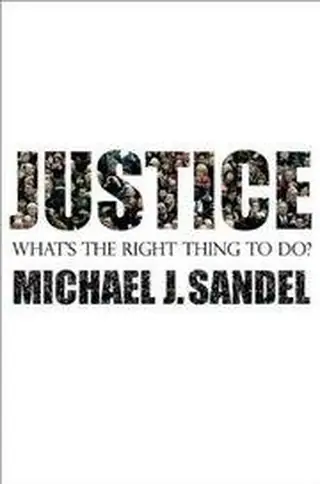
Justice: What's the Right Thing to Do? summary
by Michael J. Sandel · 2009 · 8 key ideas · 23-minute read
A tour of the great theories of justice, tested against real cases, which argues that we can't decide what's fair without also asking what's good.
Why read it
For anyone who wants to think more clearly about moral and political arguments, from price gouging to affirmative action. Sandel makes centuries of philosophy feel like a lively debate about today's headlines.
Justice: What's the Right Thing to Do? in brief
Sandel starts with real controversies: price gouging after a hurricane, who deserves military honours, bank bailouts. Behind our gut reactions, he argues, lie three big ideas about justice. One says justice means maximising welfare. Another says it means respecting freedom. A third says it means cultivating virtue and rewarding what deserves honour.
He then walks through each tradition. Utilitarians like Bentham and Mill seek the greatest happiness. Libertarians argue that we own ourselves, so the state shouldn't redistribute what we earn. Kant grounds morality in reason and in treating people as ends, never merely as means. Rawls asks what principles we'd choose behind a veil of ignorance about our own place in society.
Each theory is tested against hard cases: shipwrecked sailors who ate the cabin boy, paying people to serve in wars, surrogate motherhood, affirmative action, a disabled golfer's request to use a cart. These cases show the strengths and blind spots of each approach.
Sandel's own view emerges at the end. Theories that try to be neutral about the good life, he argues, can't settle the hardest questions. Justice involves judging what things are for and what virtues they honour. He calls for a politics of the common good, in which citizens argue openly about moral questions rather than avoiding them.
The 8 key ideas
1. Three ways to think about justice
Welfare, freedom, virtue: ask which one the argument is really about.
2. The limits of adding up happiness
The numbers matter, but people aren't just numbers.
3. Not all pleasures are equal
What you enjoy most isn't always what you value most.
4. Do we own ourselves?
Own yourself? Ask what else made you.
5. Right motive, real respect
Do right because it's right, and never treat people as mere tools.
6. Behind the veil of ignorance
Design the rules as if you might draw the shortest straw.
7. What is it for?
Before asking who deserves it, ask what it's for.
8. A politics of the common good
Respect means arguing with people's convictions, not ignoring them.
Read the full guide in Kinquire. Every idea with a real example, a diagram and one thing to try today, plus a quick quiz so it sticks. Free to start.
Read Justice: What's the Right Thing to Do?Key takeaways
- Sort arguments by whether they appeal to welfare, freedom or virtue.
- Check cost-benefit reasoning for people's rights and dignity.
- Ask whether you'd accept a rule without knowing if you'd win or lose by it.
- Ask what an institution is for before deciding who deserves its rewards.
- Engage the moral convictions of people you disagree with instead of avoiding them.
Our take
Justice is a model of public philosophy: clear, fair to opposing views and grounded in vivid cases. It's an excellent introduction to utilitarianism, libertarianism, Kant, Rawls and Aristotle. Its limits are those of any survey: some theories are simplified, and its own communitarian conclusion is less fully developed than its critiques of others. Some liberal readers think Sandel underrates the dangers of bringing contested moral views into politics. Its examples are mostly American and Western. But as a guide to thinking about real moral disagreements, and seeing what's really at stake in them, it has held up very well.
About Michael J. Sandel
Michael J. Sandel is a political philosopher at Harvard University. His undergraduate course on justice became one of the university's most popular and was later made freely available online.
If you liked this
- Nicomachean Ethics by Aristotle
- The Republic by Plato
- Meditations by Marcus Aurelius
- Letters from a Stoic by Seneca
- The Enchiridion by Epictetus
- The Obstacle Is the Way by Ryan Holiday