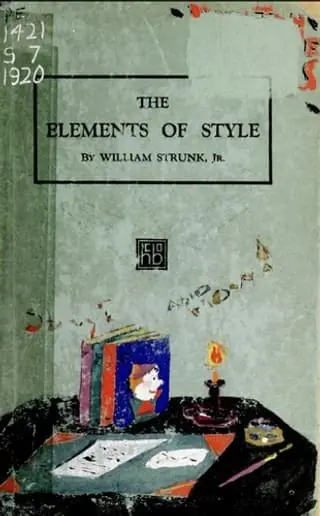
The Elements of Style summary
by William Strunk Jr. and E.B. White · 1959 · 7 key ideas · 16-minute read
A slim, famous rulebook for clear English: omit needless words, prefer the active and the positive, be specific, and put yourself in the background.
Why read it
For anyone who writes anything. It's short enough to read in an afternoon, and its core principles still sharpen emails, essays and reports, provided you treat its rules as strong defaults rather than laws.
The Elements of Style in brief
The Elements of Style began as Strunk's privately printed handbook for his Cornell students. Decades later, E.B. White, who had taken Strunk's class, revised it and added an introduction and a final chapter on style. The result, published in 1959, became one of the best-known writing guides in English.
The book opens with elementary rules of usage: how to form possessives, where commas belong, how to handle parenthetical phrases and independent clauses, and how to avoid dangling participles. These short rules aim to remove the small errors that distract readers.
Next come the principles of composition, the heart of the book: choose a design and hold to it, make the paragraph the unit of composition, use the active voice, put statements in positive form, use definite and concrete language, omit needless words, express parallel ideas in parallel form, and place emphatic words at the end.
Later sections cover matters of form and a list of commonly misused words and expressions. White's closing chapter, An Approach to Style, offers gentler advice: place yourself in the background, write naturally, revise, avoid overwriting and overstatement, and above all be clear.
The 7 key ideas
1. Omit needless words
Make every word tell.
2. Use the active voice
Say who did what.
3. Say it positively
Tell them what is, not what isn't.
4. Be specific and concrete
Don't say 'bad weather'. Say what fell from the sky.
5. Shape sentences for emphasis
Save the strongest word for last.
6. Plan the shape first
One paragraph, one job.
7. Place yourself in the background
Get out of the way and let the meaning through.
Read the full guide in Kinquire. Every idea with a real example, a diagram and one thing to try today, plus a quick quiz so it sticks. Free to start.
Read The Elements of StyleKey takeaways
- Cut phrases that use several words where one will do.
- Prefer active sentences that say who did what.
- Replace 'not' phrases with positive words where you can.
- Swap abstractions for specific, concrete details.
- End sentences on your most important word.
- Write topic sentences first, one per paragraph.
Our take
The Elements of Style has endured because its best advice (omit needless words, be specific, prefer the active and positive, plan your structure) genuinely improves most writing, and it's short enough to reread often. Its weaknesses are real, though. Some usage rules are outdated or reflect personal taste, and linguists have criticised its grammar as confused in places, especially on the passive voice. Applied mechanically, its rules can make prose choppy and timid. White's own closing chapter is gentler and wiser than some of the rules. Treat it as a set of strong defaults, and pair it with a modern usage guide.
About William Strunk Jr. and E.B. White
William Strunk Jr. was an English professor at Cornell University who first printed the book privately for his students. E.B. White, his former student, was a New Yorker essayist and the author of Charlotte's Web, and he revised and expanded the book in 1959.
If you liked this
- On Writing Well by William Zinsser
- On Writing by Stephen King
- Steal Like an Artist by Austin Kleon
- The War of Art by Steven Pressfield
- Big Magic by Elizabeth Gilbert
- The Artist's Way by Julia Cameron