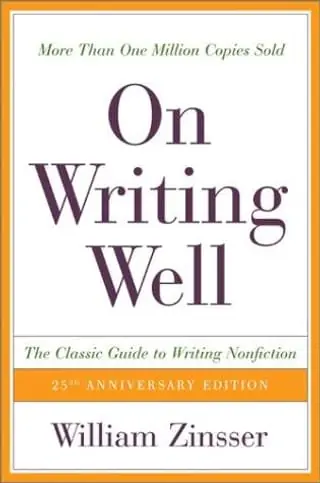
On Writing Well summary
by William Zinsser · 1976 · 7 key ideas · 16-minute read
Good nonfiction is clear, simple, warm and human: strip out clutter, write as yourself, and rewrite until every word earns its place.
Why read it
For anyone who writes nonfiction, from emails and reports to articles and memoir. It's the classic guide to plain, lively prose and is itself a model of the style it teaches.
On Writing Well in brief
Zinsser starts from the idea that writing is a transaction between two people. What makes nonfiction succeed is humanity and warmth: the reader should feel a real person on the other side of the page. The enemy of that connection is clutter, the needless words, jargon and pompous phrasing that bury meaning.
The first part covers principles: simplicity, fighting clutter, finding your own style rather than imitating one, remembering that you write mainly for yourself, choosing and using words carefully, and keeping unity of pronoun, tense and mood. Clear writing, he insists, comes from clear thinking.
Next come methods: how to write a lead that hooks the reader and an ending that knows when to stop, and practical notes on verbs, adjectives, qualifiers, punctuation and paragraphs. Then he walks through forms of nonfiction, including interviews, travel writing, memoir, science, business, sports, criticism and humour, showing how the same principles apply.
The final section is about attitudes: the sound of your own voice, enjoyment and fear, and making decisions as a writer. Zinsser urges writers to care about craft, to rewrite tirelessly, and to write as well as they can, because what they leave behind will speak for them.
The 7 key ideas
1. Writing is a transaction
Put a person on the page.
2. Simplicity
Clear thinking first. Clear writing follows.
3. Fight clutter
Every word must earn its place.
4. Be yourself, write for yourself
Style is you, on a good day, being clear.
5. Keep it unified
Decide your one point, then serve only it.
6. Hook them, then stop
Grab them in line one. Let them go early.
7. Rewriting is writing
First drafts are for you. Rewrites are for readers.
Read the full guide in Kinquire. Every idea with a real example, a diagram and one thing to try today, plus a quick quiz so it sticks. Free to start.
Read On Writing WellKey takeaways
- Ask 'What am I trying to say?' before you write.
- Bracket and cut every word that isn't doing work.
- Write in your own voice, as if talking to a smart friend.
- Choose one main point and stick to one pronoun, tense and mood.
- Make the first sentence irresistible and end sooner than expected.
- Rewrite several times, favouring strong verbs and short words.
Our take
On Writing Well has guided generations of writers because its advice is clear, practical and modelled in its own prose. Its principles (simplicity, warmth, cutting clutter, rewriting) apply to almost all nonfiction, from emails to memoir. Its limits are mainly of era and scope: many examples come from mid-twentieth-century American journalism, it says relatively little about digital formats, and its strong preference for a plain, conversational style isn't the only good style. Some rules, such as distrusting adverbs and the passive, are best treated as defaults rather than absolutes. Still, it remains one of the best single books on writing clearly.
About William Zinsser
William Zinsser was an American writer, editor and teacher who worked at the New York Herald Tribune and taught a nonfiction writing course at Yale, from which this book grew. He revised it through many editions.
If you liked this
- The Elements of Style by William Strunk Jr. and E.B. White
- On Writing by Stephen King
- Bird by Bird by Anne Lamott
- Steal Like an Artist by Austin Kleon
- The War of Art by Steven Pressfield
- Big Magic by Elizabeth Gilbert