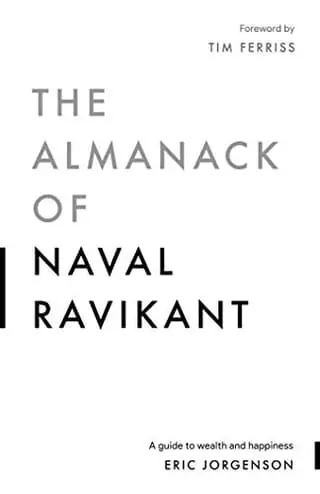
The Almanack of Naval Ravikant summary
by Eric Jorgenson · 2020 · 7 key ideas · 19-minute read
Build wealth through specific knowledge, leverage and accountability, and build happiness through habits of mind, since both are skills you can learn.
Why read it
For anyone thinking about career, money and meaning, especially people drawn to building their own thing. It condenses years of Naval's tweets and interviews into one compact, quotable guide.
The Almanack of Naval Ravikant in brief
The Almanack is not a book Naval wrote, but a curated collection of his ideas, gathered by Eric Jorgenson from tweets, podcasts and interviews, and organised into two parts: wealth and happiness. The tone is aphoristic: short, dense lines meant to be reread.
On wealth, Naval argues that anyone can get rich without getting lucky. Seek wealth, meaning assets that earn while you sleep, not just money or status. Build specific knowledge that can't be easily taught, take accountability under your own name, and use leverage, especially code and media, which anyone can use without permission. Play long-term games with long-term people.
Because leverage multiplies the effect of every decision, judgment becomes the most valuable skill. Naval recommends reading widely, learning foundational subjects such as maths and persuasion, thinking clearly from first principles, and learning both to build and to sell, since people who can do both are rare.
On happiness, Naval argues that it is a skill and a choice, not a reward. Desire is a contract to be unhappy until you get what you want, so choose desires carefully. Peace comes from accepting reality, building healthy habits and caring for your body and mind. The book ends with his recommended reading.
The 7 key ideas
1. Seek wealth, not money or status
Earn with your time; get wealthy with what you own.
2. Find your specific knowledge
If it feels like play to you and work to others, follow it.
3. Use permissionless leverage
Code and media work while you sleep.
4. Take accountability
Put your name on it.
5. Play long-term games
Compound interest works on trust too.
6. Judgment is the multiplier
Leverage multiplies decisions, so get the decisions right.
7. Happiness is a skill
Every desire is a contract to be unhappy until it's fulfilled.
Read the full guide in Kinquire. Every idea with a real example, a diagram and one thing to try today, plus a quick quiz so it sticks. Free to start.
Read The Almanack of Naval RavikantKey takeaways
- Build or buy assets that can earn without your time, rather than relying only on a salary.
- Notice which work feels like play to you and invest in it.
- Turn something you do repeatedly into code or media.
- Put your name on your work and accept public accountability.
- Choose long-term partners carefully and protect trust.
- Choose fewer desires and build daily habits for a calmer mind.
Our take
The Almanack is a compact, inspiring distillation of ideas many people find clarifying, especially the framework of specific knowledge, leverage and accountability. Its format is also its weakness: aphorisms can be quotable but vague, and a collection of tweets and interview excerpts lacks evidence, depth and nuance. The advice reflects the perspective of a successful Silicon Valley investor and can understate luck, privilege and structural barriers. The happiness section borrows from older traditions without much new. Read it as a set of prompts for reflection rather than a step-by-step plan.
About Eric Jorgenson
Eric Jorgenson is an entrepreneur and writer who compiled the book from Naval Ravikant's tweets, podcasts and essays. Naval Ravikant is an entrepreneur and investor who co-founded AngelList.
If you liked this
- Meditations by Marcus Aurelius
- So Good They Can't Ignore You by Cal Newport
- Zero to One by Peter Thiel with Blake Masters
- The Lean Startup by Eric Ries
- The Hard Thing About Hard Things by Ben Horowitz
- The E-Myth Revisited by Michael E. Gerber