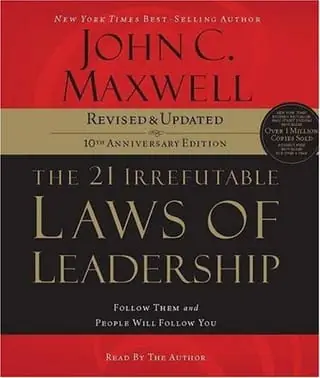
The 21 Irrefutable Laws of Leadership summary
by John C. Maxwell · 1998 · 7 key ideas · 17-minute read
Leadership is influence, and it follows a set of principles — from the ‘lid’ your leadership puts on your success to the legacy you leave through other leaders.
Why read it
For people early in their leadership journey who want a broad, memorable map of what leadership involves. Each law is short and stands alone, so it works well as a checklist for self-assessment.
The 21 Irrefutable Laws of Leadership in brief
Maxwell sets out 21 principles he believes hold true for leaders in any field, era or culture. Each law gets its own short chapter with a one-line statement, stories from history, business, sport and church life, and questions for self-reflection, so readers can test themselves law by law.
The foundation is that leadership is influence — not a title or position. Your leadership ability acts as a lid on how effective you can be, and it grows through a long, daily process rather than in a single moment. Leaders chart the course for others, earn trust through character, and must connect with people emotionally before asking them to follow.
Several laws deal with how leaders multiply their impact: surrounding themselves with a strong inner circle, giving power away instead of hoarding it, and developing other leaders rather than just gathering followers. Others cover momentum, priorities, sacrifice and timing — doing the right thing at the right moment.
The final law is about legacy: a leader's lasting value is measured by the people they develop who carry on after them. A revised tenth-anniversary edition (2007) replaced a couple of the original laws and updated many examples, but the core message is unchanged — anyone can learn to lead better.
The 7 key ideas
1. The Law of the Lid
Your leadership is the lid on your success.
2. Influence is the real measure
If nobody follows, you're just taking a walk.
3. Chart the course
Plan the journey before you ask anyone to walk it.
4. Touch a heart before asking for a hand
People buy the leader before they buy the plan.
5. Only secure leaders give power away
Give power away and your power grows.
6. The Law of Timing
Right idea, wrong moment — still wrong.
7. Multiply leaders, build a legacy
Success is what you build; legacy is who you build.
Read the full guide in Kinquire. Every idea with a real example, a diagram and one thing to try today, plus a quick quiz so it sticks. Free to start.
Read The 21 Irrefutable Laws of LeadershipKey takeaways
- Treat leadership as a skill that raises the ceiling on everything else you do.
- Measure your leadership by who chooses to follow you, not by your title.
- Plan the route and the risks before you commit people to a course.
- Connect with people's real concerns before asking them to act.
- Give away authority and develop other leaders to multiply your impact.
Our take
The 21 Laws is clear, upbeat and easy to apply, which is why it has sold so widely and is often a first leadership book. Its weaknesses are mostly about rigour. The ‘irrefutable laws’ are really principles drawn from anecdotes, not research, and some overlap heavily. Many stories are retold history chosen to fit the point, and some are simplified. The focus on charismatic individual leaders gives less attention to systems, teams and context. Readers looking for evidence-based leadership will want other sources, but as a broad, motivating overview it still does its job.
About John C. Maxwell
John C. Maxwell is an American author, speaker and former pastor who has written dozens of books on leadership. He founded several organisations that train leaders around the world.
If you liked this
- Multipliers by Liz Wiseman
- Good to Great by Jim Collins
- Built to Last by Jim Collins and Jerry I. Porras
- The Innovator's Dilemma by Clayton M. Christensen
- Blue Ocean Strategy by W. Chan Kim and Renée Mauborgne
- Good Strategy Bad Strategy by Richard Rumelt