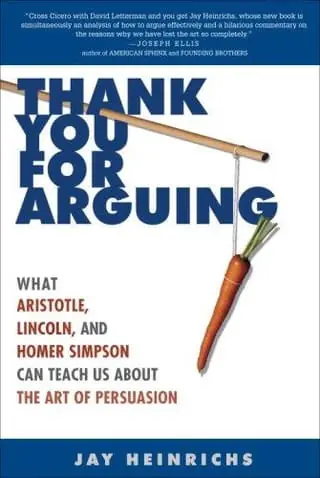
Thank You for Arguing summary
by Jay Heinrichs · 2007 · 8 key ideas · 19-minute read
Classical rhetoric — Aristotle's and Cicero's art of persuasion — is a practical everyday toolkit: set a clear goal, argue about the future, earn trust, stir the right emotion, reason from shared beliefs and fit your audience.
Why read it
For anyone who argues at work, at home or online and wants to persuade instead of just winning points. It makes 2,000-year-old ideas lively, modern and immediately usable.
Thank You for Arguing in brief
Heinrichs argues that we have forgotten an ancient art. For centuries, rhetoric — the study of persuasion — was at the heart of education. Today we mostly fight instead of arguing: we try to beat the other person, rather than win them over. He sets out to revive the tools of Aristotle, Cicero and their successors for modern life, using examples from family arguments, politics and popular culture.
The first step is to know what you want. Are you trying to change someone's mood, their mind or their willingness to act? Then choose the right tense: arguments about the past assign blame, arguments about the present debate values, but only arguments about the future lead to choices and action.
Heinrichs then explains Aristotle's three appeals. Ethos, argument by character, makes the audience trust you. Pathos, argument by emotion, makes them care. Logos, argument by logic, gives them reasons — ideally built on beliefs they already hold. He adds the power of concession, the importance of fitting your audience's expectations, and the art of timing.
Along the way he teaches defence: how to spot logical fallacies, how to recognise manipulation and how to keep an argument productive. The goal, he says, is not domination but consensus — getting people to agree with you and act, while keeping the relationship intact.
The 8 key ideas
1. Argue, don't fight
Win the person, not the point.
2. Argue in the future tense
Blame looks back; choice looks forward.
3. Ethos: earn the right to persuade
Trust first, then argue.
4. Pathos: stir the right emotion
Show the scene; let them feel it.
5. Logos: argue from what they already believe
Start from their beliefs, not yours.
6. Concede to win
Give a little ground to win the field.
7. Fit the audience and the moment
Right words, right room, right time.
8. Spot bad logic
Name the trick quietly, then steer back.
Read the full guide in Kinquire. Every idea with a real example, a diagram and one thing to try today, plus a quick quiz so it sticks. Free to start.
Read Thank You for ArguingKey takeaways
- Decide whether you want to change mood, mind or action before you speak.
- Shift arguments from blame (past) to choices (future).
- Show shared values, relevant experience and that you're not just serving yourself.
- Use plain, concrete stories to stir emotion.
- Build arguments from the audience's own beliefs.
- Concede what you can, then redirect towards what matters.
Our take
Thank You for Arguing is witty, accessible and genuinely useful; it gives readers a framework for everyday persuasion that most schools no longer teach. Its strengths are its practical tools and lively examples. Some readers find its jokey tone and heavy use of pop culture distracting, and its interpretations of classical rhetoric are simplified for a general audience. Because it teaches techniques that can manipulate as well as persuade, readers must bring their own ethics. Still, as an introduction to rhetoric and its everyday uses, it is hard to beat.
About Jay Heinrichs
Jay Heinrichs is an American writer and former magazine editor who teaches and speaks about rhetoric. Thank You for Arguing has been revised and expanded in later editions.
If you liked this
- Influence by Robert B. Cialdini
- Getting to Yes by Roger Fisher and William Ury
- Made to Stick by Chip Heath and Dan Heath
- The Righteous Mind by Jonathan Haidt
- How to Win Friends and Influence People by Dale Carnegie
- Crucial Conversations by Kerry Patterson, Joseph Grenny, Ron McMillan and Al Switzler