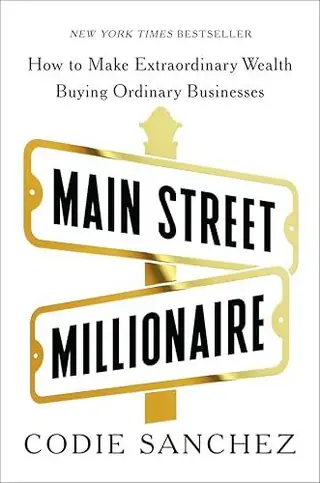
Main Street Millionaire summary
by Codie Sanchez · 2024 · 8 key ideas · 21-minute read
Instead of chasing a startup, buy a boring, profitable local business from an owner who wants out, often paying over time from its own profits, and hire someone to run it.
Why read it
For people who want to own a business but don't have a brilliant idea or a taste for startup risk. It is a practical guide to finding, financing, taking over and growing small, unglamorous businesses.
Main Street Millionaire in brief
Sanchez argues that the surest route to wealth for ordinary people isn't a tech startup but ownership of 'Main Street' businesses: laundromats, plumbers, cleaners, car washes and other unglamorous firms that have quietly made money for decades. Many are owned by people nearing retirement with no one to take over, which gives patient buyers an opening.
The book is organised around four stages that spell RICH: Research (choosing the kind of business and finding sellers), Invest (valuing, financing and negotiating the deal), Command (taking over and putting the right people in charge) and Harness (growing profits and building something sellable).
Her favourite financing tool is what she calls a profit payback: the seller lends you part of the price, and you repay them over several years from the business's own profits. This lets buyers acquire businesses without paying the full price up front, and can suit sellers too.
She is candid about the downside, including a deal in which she says she lost about $12 million in 90 days, and spends as much time on avoiding bad deals and bad partners as on finding good ones. The goal is to own a business, not a job: hire a capable operator, watch the numbers weekly and stay out of the way.
The 8 key ideas
1. Boring beats cool
Unsexy often means unchallenged.
2. Why owners sell: the seven Ds
Behind every sale is a life event.
3. Know your deal box, then search wide
Know what you want, then expect a hundred no's.
4. Find sellers before they list
The best deals arrive through a friend of the owner.
5. Let the business pay for itself
Borrow to buy what pays you back, never to buy what costs you.
6. Protect your downside first
Make sure you can't lose big before you try to win big.
7. Own a business, not a job
When you have a dog, don't do the barking.
8. Grow profit, then build to sell
Run it as if you'll sell it, even if you never do.
Read the full guide in Kinquire. Every idea with a real example, a diagram and one thing to try today, plus a quick quiz so it sticks. Free to start.
Read Main Street MillionaireKey takeaways
- Look at boring, long-established businesses before exciting new ones.
- Write a deal box and expect to review about 100 businesses to buy one.
- Tell accountants, lawyers, insurance agents and advisers what you want to buy.
- Ask sellers about paying part of the price over time from profits.
- Check everything, and change little for the first two months after buying.
- Hire and reward a strong operator, and review the numbers weekly.
Our take
Main Street Millionaire is a useful antidote to startup mythology: it shows ordinary people a realistic route to ownership and is unusually frank about losses and bad partners. Its tools, from the deal box to the takeover plan, are concrete. But it can make buying sound easier than it is. Good businesses attract competing buyers, many sellers want most of the price in cash, and seller financing still leaves you personally on the hook if profits fall. The book is US-centred in its tax and lending details, and the author also sells training and a community on the same subject, so some enthusiasm is to be expected. Use it alongside professional advice.
About Codie Sanchez
Codie Sanchez is an American investor who worked in finance before founding Contrarian Thinking, a media company and community about buying and running small businesses.
If you liked this
- Buy Then Build by Walker Deibel
- The E-Myth Revisited by Michael E. Gerber
- Built to Sell by John Warrillow
- Never Enough by Andrew Wilkinson
- Zero to One by Peter Thiel with Blake Masters
- The Lean Startup by Eric Ries