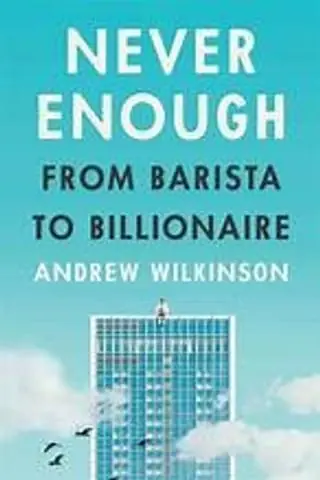
Never Enough summary
by Andrew Wilkinson · 2024 · 7 key ideas · 19-minute read
A barista-turned-billionaire's honest account of how he built a fortune by buying and keeping good businesses, and why the money didn't fix what he hoped it would.
Why read it
For ambitious people who assume a big enough number will bring peace. It mixes practical business lessons, such as delegation and buying instead of building, with a rare, candid look at what wealth does and doesn't change.
Never Enough in brief
Wilkinson was making coffee for about $6.50 an hour when he noticed that two of his regular customers designed websites for a living. He taught himself, started freelancing and turned that into MetaLab, a design agency whose clients came to include fast-growing tech companies such as Slack. The agency made him rich young.
The book is honest about what came next. Early success made him overconfident, and he started venture after venture, losing heavily on several, including a software product that cost him, by his account, more than $10 million. Reading about Warren Buffett and Charlie Munger changed his approach: instead of starting businesses, he and his partner Chris Sparling began buying profitable ones, keeping them for the long term and hiring people to run them. That became Tiny.
The second half turns inward. Wilkinson describes reaching a fortune he had dreamed of and finding that his anxiety, his comparisons with richer people and the strain on his relationships all came with him. He writes about the end of his marriage, his mental health and the odd loneliness of great wealth.
His conclusions are practical as well as personal: design your work around what you don't want, decide what 'enough' means before you chase more, and use money for freedom and for others rather than for status. He says he plans to give most of his fortune away.
The 7 key ideas
1. Sell other people's time
Your hours are capped. A team's aren't.
2. Easy early wins can mislead you
One easy win doesn't make every lift light.
3. Buy good businesses instead of starting them
Why start from zero when someone will sell you a working machine?
4. Hire people better than you, then step back
Own the business. Don't be its bottleneck.
5. Set anti-goals
Know where you'd hate to end up, and never go there.
6. More money, same brain
Wherever you go, your brain goes too.
7. Decide what enough is
If you never define enough, you'll never have it.
Read the full guide in Kinquire. Every idea with a real example, a diagram and one thing to try today, plus a quick quiz so it sticks. Free to start.
Read Never EnoughKey takeaways
- Hand off one task a week that others could do as well as you.
- Judge each new venture on its own economics, not on your past wins.
- Consider buying a working business before starting from zero.
- Write anti-goals: rules that protect you from your worst day.
- Define what 'enough' means for you, in numbers.
- Decide what extra money is for before you chase it.
Our take
Never Enough stands out for its honesty: few business memoirs admit to large losses, loneliness and anxiety alongside the wins, and its practical lessons on delegation, buying businesses and anti-goals are genuinely useful. Its limits are those of any memoir. The lessons come from one unusual life, helped by good timing in the tech boom and by luck the author acknowledges. Buying businesses needs capital most readers don't have. And warnings that money won't make you happy are easier to accept from someone who no longer worries about rent. Read it as a thoughtful counterweight to hustle books rather than a blueprint.
About Andrew Wilkinson
Andrew Wilkinson is a Canadian entrepreneur who co-founded the design agency MetaLab and Tiny, a publicly traded holding company that owns internet businesses such as Dribbble and Letterboxd.
If you liked this
- The Psychology of Money by Morgan Housel
- Buy Then Build by Walker Deibel
- Die with Zero by Bill Perkins
- Rework by Jason Fried and David Heinemeier Hansson
- Zero to One by Peter Thiel with Blake Masters
- The Lean Startup by Eric Ries