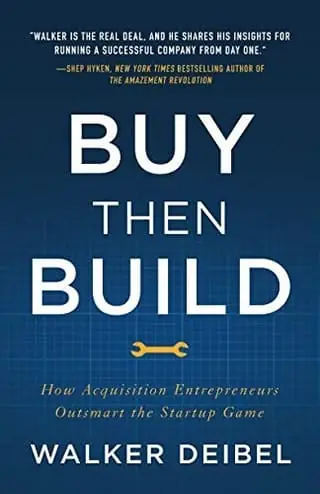
Buy Then Build summary
by Walker Deibel · 2018 · 7 key ideas · 16-minute read
Instead of starting a business from scratch, buy an existing profitable small business and grow it from there.
Why read it
For anyone who wants to run their own business but finds the odds of start-ups daunting. Deibel explains a route most people never consider, and how to do it carefully.
Buy Then Build in brief
Most people who want to be their own boss assume they must start something new. Deibel argues that this is often the riskiest path: a start-up has no customers, no proven product and no income on day one. Buying an established small business that already makes money can be a safer way in.
He calls this acquisition entrepreneurship. You still act as an entrepreneur, but you begin with customers, staff, systems and cash flow already in place, then build on them. Many owners of solid small businesses are approaching retirement with no obvious successor, so good businesses come up for sale.
The book covers the whole journey: deciding what kind of business suits you, searching for deals, understanding how small businesses are valued, financing the purchase (often with loans and help from the seller), checking everything carefully before you sign, and managing the handover.
The second half of the title matters as much as the first. After buying, the job is to build: improve the business, grow it and make it less dependent on any one person, which is where much of the value is created.
The 7 key ideas
1. Start with cash flow, not a blank page
Begin with customers, not a blank page.
2. Good businesses come up for sale
Boring, profitable and for sale is a great combination.
3. How small businesses are valued
Price follows earnings and how safe they are.
4. Use other people's money, carefully
Let the business pay for itself, with room to spare.
5. Check everything before you sign
Trust the seller; verify the business.
6. Then build
Buy a foundation; build the house.
7. Is this route right for you?
Some entrepreneurs invent; others improve. Both count.
Read the full guide in Kinquire. Every idea with a real example, a diagram and one thing to try today, plus a quick quiz so it sticks. Free to start.
Read Buy Then BuildKey takeaways
- Consider buying an existing profitable business instead of starting from scratch.
- Look at unglamorous, essential local businesses where owners may be retiring.
- Understand valuation as a multiple of the owner's earnings.
- Make sure the business's cash flow can comfortably cover any loans.
- Check everything carefully, with professional help, before signing.
- After buying, build: improve, grow and reduce dependence on any one person.
Our take
The book opens many readers' eyes to a credible alternative to start-ups, and it explains the mechanics of buying a small business clearly. Its view of the risks of starting from scratch is persuasive. Its limits are that much of the financing detail is specific to the United States, and the path requires money or borrowing capacity that many readers will not have. It can also make the process sound more orderly than it is: searches are long, many deals fall through and running a business you bought is still hard work. As an introduction to acquisition entrepreneurship, though, it is clear and useful.
About Walker Deibel
Walker Deibel is an American entrepreneur and investor who has bought and run several small businesses, and who promotes what he calls acquisition entrepreneurship.
If you liked this
- Main Street Millionaire by Codie Sanchez
- The E-Myth Revisited by Michael E. Gerber
- Built to Sell by John Warrillow
- Profit First by Mike Michalowicz
- Zero to One by Peter Thiel with Blake Masters
- The Lean Startup by Eric Ries