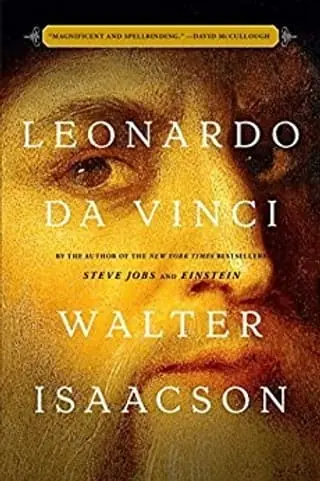
Leonardo da Vinci summary
by Walter Isaacson · 2017 · 7 key ideas · 17-minute read
A biography built from Leonardo's notebooks, showing how relentless curiosity, careful observation and a love of both art and science made him history's archetypal creative genius.
Why read it
For anyone who wants to be more curious and creative — Isaacson argues Leonardo's genius came from habits we can all practise, not superhuman gifts.
Leonardo da Vinci in brief
Leonardo was born in 1452 near Vinci, the illegitimate son of a notary. Isaacson argues that this outsider status was a blessing: he was spared a classical Latin education and the family profession, so he learned from direct experience instead. As a teenager he was apprenticed to Andrea del Verrocchio in Florence, where he learned painting, sculpture, engineering and stagecraft.
Around 1482 he moved to Milan, offering Duke Ludovico Sforza his skills mainly as a military engineer. There he staged spectacular court pageants, planned a giant bronze horse that was never cast, painted The Last Supper, and filled notebooks with studies of anatomy, flight, water, optics and geometry.
After Milan fell to the French, he worked in Florence, briefly for Cesare Borgia as an engineer, and in Rome. He began the Mona Lisa, which he kept refining for years, and pushed his anatomical studies further, dissecting human bodies and making discoveries about the heart that were confirmed only centuries later.
He spent his final years in France under King Francis I and died in 1519, leaving many projects unfinished. Isaacson's conclusion is that Leonardo's genius lay in his curiosity, observation and blending of art and science — and he ends with practical lessons for readers who want to think more like him.
The 7 key ideas
1. Be relentlessly curious
Ask why the sky is blue — and keep asking.
2. A disciple of experience
Trust what you've seen, then go and see more.
3. Observe what others miss
Look longer than feels necessary.
4. Art and science are one
Genius lives where disciplines meet.
5. Think on paper
Ideas you don't write down evaporate.
6. The perfectionist who rarely finished
Let ideas ripen, but ship before they rot.
7. Let imagination meet reality
Dream like a child, test like an engineer.
Read the full guide in Kinquire. Every idea with a real example, a diagram and one thing to try today, plus a quick quiz so it sticks. Free to start.
Read Leonardo da VinciKey takeaways
- Keep a list of 'useless' questions and look into one each day.
- Test received wisdom against your own observation.
- Practise looking longer at ordinary things.
- Combine skills from different fields to create something new.
- Carry a notebook and think on paper.
- Give ideas time to ripen, but decide when to finish.
Our take
Isaacson's book is accessible, richly illustrated and full of practical lessons, and it brings Leonardo's notebooks to life for general readers. Its strength is synthesis rather than new scholarship. Art historians have noted that it sometimes leans on contested attributions, such as the Salvator Mundi, and occasionally reads modern ideas — 'innovation', 'thinking different' — into a Renaissance life. The self-help framing can flatten the strangeness of the past. Still, it's an excellent introduction and a persuasive case that curiosity can be cultivated.
About Walter Isaacson
Walter Isaacson has written biographies of Steve Jobs, Einstein and Benjamin Franklin, and is a professor of history at Tulane University. He based this book largely on Leonardo's surviving notebooks.
If you liked this
- Steve Jobs by Walter Isaacson
- Einstein: His Life and Universe by Walter Isaacson
- Range by David Epstein
- Sapiens by Yuval Noah Harari
- Guns, Germs, and Steel by Jared Diamond
- The Silk Roads by Peter Frankopan