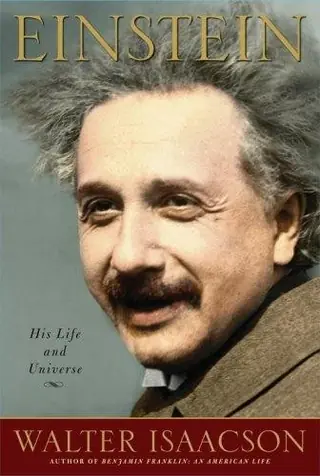
Einstein: His Life and Universe summary
by Walter Isaacson · 2007 · 7 key ideas · 18-minute read
The life of the twentieth century's most famous scientist, showing how imagination, nonconformity and a rebellious streak produced relativity — and later made him resist quantum physics.
Why read it
For anyone who wants to understand how original thinking happens, explained clearly enough that you don't need a physics background.
Einstein: His Life and Universe in brief
Albert Einstein was born in Ulm, Germany, in 1879 and grew up in Munich. He was slow to speak as a child but deeply curious, enchanted by a compass his father showed him. He hated the rote drills of German schools and left, finishing his schooling in Switzerland, where a freer style of teaching encouraged him to think visually.
After studying at the Zurich Polytechnic, he couldn't get an academic post and became a patent examiner in Bern. In 1905, aged 26, he published a series of papers that transformed physics: on light quanta, the size of molecules, Brownian motion, special relativity and the equivalence of mass and energy.
Over the next decade he generalised relativity to include gravity, completing general relativity in 1915. When a 1919 solar eclipse confirmed his prediction that gravity bends light, he became a global celebrity. He won the Nobel Prize for his work on the photoelectric effect.
Yet Einstein grew uneasy with the quantum theory he had helped start. He spent decades debating Niels Bohr and searching, unsuccessfully, for a unified field theory. Meanwhile his personal life — two marriages, distant relationships with his sons — was often difficult.
A Jew and a pacifist, he left Nazi Germany in 1933 for Princeton. He signed a 1939 letter warning President Roosevelt that Germany might build an atomic bomb, and later campaigned for arms control and civil liberties. He died in 1955. Isaacson argues that his genius came from imagination and a love of freedom.
The 7 key ideas
1. Keep your sense of wonder
The ordinary is just the unexplained we've stopped noticing.
2. Think in pictures
Picture it before you prove it.
3. Question what everyone assumes
The biggest errors hide in what no one questions.
4. The outsider's advantage
Being outside the walls means seeing them.
5. Persist through wrong turns
Stubborn on vision, flexible on details.
6. When the rebel resists
Today's rebel can be tomorrow's resister.
7. Freedom and conscience
Imagination needs room to breathe.
Read the full guide in Kinquire. Every idea with a real example, a diagram and one thing to try today, plus a quick quiz so it sticks. Free to start.
Read Einstein: His Life and UniverseKey takeaways
- Keep asking simple questions about everyday things.
- Picture your problem as a scene before formalising it.
- Identify and challenge the assumption everyone takes for granted.
- Use an outsider position as freedom, not just exclusion.
- Persist on the big idea while abandoning flawed versions.
- Watch for becoming attached to your own past breakthroughs.
Our take
Isaacson's biography is clear, balanced and accessible, explaining the physics well enough for general readers while giving equal weight to Einstein's personal life, using his then newly released letters. Some physicists find the science explanations simplified, and the book is stronger on narrative than on technical depth. Isaacson's framing of Einstein as a model of creative nonconformity can be tidy, but he is honest about Einstein's failings as a husband and father. For deeper physics, Abraham Pais's Subtle Is the Lord is the classic scientific biography.
About Walter Isaacson
Walter Isaacson is a former chairman of CNN and managing editor of Time, and the author of biographies of Benjamin Franklin, Steve Jobs and Leonardo da Vinci. For this book he drew on Einstein's newly released personal letters.
If you liked this
- Leonardo da Vinci by Walter Isaacson
- Surely You're Joking, Mr. Feynman! by Richard P. Feynman
- A Brief History of Time by Stephen Hawking
- Sapiens by Yuval Noah Harari
- Guns, Germs, and Steel by Jared Diamond
- The Silk Roads by Peter Frankopan