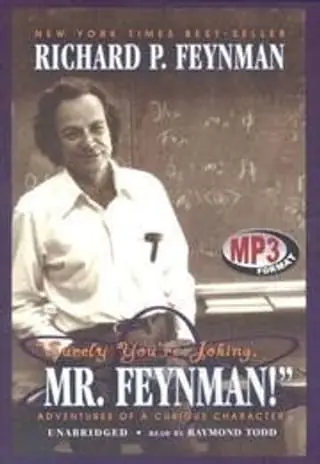
Surely You're Joking, Mr. Feynman! summary
by Richard P. Feynman · 1985 · 7 key ideas · 17-minute read
Funny, mischievous stories from a Nobel physicist that reveal a way of thinking: playful curiosity, real understanding and refusing to fool yourself.
Why read it
For anyone who wants to think more clearly and enjoy learning more — Feynman shows that curiosity and honesty are habits you can practise.
Surely You're Joking, Mr. Feynman! in brief
This is not a conventional autobiography but a collection of anecdotes, told aloud to a friend, drummer Ralph Leighton, and lightly edited. They run from Feynman's boyhood in Far Rockaway, New York, where he fixed radios, through MIT and Princeton, to the atomic bomb project at Los Alamos and his professorships at Cornell and Caltech.
Along the way he picks locks and cracks safes at Los Alamos, learns to draw and sells his art under a pseudonym, plays drums in a Brazilian samba band, decodes Mayan astronomical tables and tests his own mind with odd experiments. The tone is light, boastful and irreverent.
Beneath the jokes is a philosophy. Feynman loved figuring things out for their own sake. He distrusted pomposity, authority and memorised knowledge without understanding. When he burned out, he rediscovered physics by playing with it — and that play led to Nobel Prize-winning work.
The book ends with 'Cargo Cult Science', his 1974 commencement speech at Caltech, urging scientists to practise a rigorous honesty: report what could disprove your ideas and, above all, don't fool yourself, because you are the easiest person to fool.
The 7 key ideas
1. Play beats pressure
Stop trying to be important — play.
2. Understand, don't memorise
If you can't explain it simply, you don't own it yet.
3. Carry a different box of tools
Different tools crack different problems.
4. Don't fool yourself
You are the easiest person to fool.
5. Respect ideas, not rank
Argue with the idea, not the title.
6. Look for the human weak spot
Systems are only as strong as their users' habits.
7. Be curious about everything
Everything is interesting if you look closely.
Read the full guide in Kinquire. Every idea with a real example, a diagram and one thing to try today, plus a quick quiz so it sticks. Free to start.
Read Surely You're Joking, Mr. Feynman!Key takeaways
- When work feels heavy, play with it instead.
- Test your understanding by explaining it simply with real examples.
- Learn tools from unexpected places.
- Actively look for evidence that could prove you wrong.
- Judge ideas on merit, not on who says them.
- Explore unrelated interests to keep your mind flexible.
Our take
Feynman's stories are hugely entertaining and full of insight about learning, curiosity and scientific honesty; 'Cargo Cult Science' alone is worth the book. But they are anecdotes told by a natural showman, polished by retelling, and Feynman is always the clever hero. Some chapters, especially those about his approaches to women, read as sexist today and have been widely criticised. The book also says little about the physics itself or the moral weight of the bomb. James Gleick's Genius offers a fuller biography.
About Richard P. Feynman
Richard Feynman (1918–1988) was an American physicist who shared the 1965 Nobel Prize in Physics for work on quantum electrodynamics, worked on the Manhattan Project and became a famous teacher. The stories were recorded in conversations with his friend Ralph Leighton and edited by Edward Hutchings.
If you liked this
- Einstein: His Life and Universe by Walter Isaacson
- Sapiens by Yuval Noah Harari
- Guns, Germs, and Steel by Jared Diamond
- The Silk Roads by Peter Frankopan
- SPQR by Mary Beard
- The Rise and Fall of the Third Reich by William L. Shirer