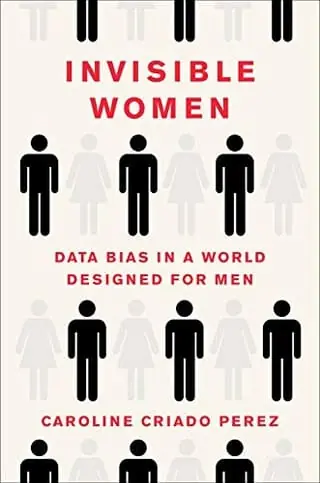
Invisible Women summary
by Caroline Criado Perez · 2019 · 7 key ideas · 20-minute read
Because so much data and design has treated men as the default human, the world is often built badly for women, with costs to their time, health and safety.
Why read it
For designers, managers, policymakers and anyone who builds things for people. It shows how gaps in data lead to products and policies that quietly fail half the population.
Invisible Women in brief
Criado Perez argues that much of the world is designed around a default male. When researchers collect data, design products or plan cities, they often assume the typical human is a man, and fail to collect separate data on women. She calls the result the gender data gap.
The gap, she says, is not usually the product of deliberate sexism. It comes from not thinking about women at all. Because the people making decisions have often been men, their experiences have been taken as universal, and women's different bodies, schedules and needs have been overlooked.
She documents this across daily life: city planning and public transport, workplaces and protective equipment, product design, medicine and clinical research, the economy's treatment of unpaid care work, and responses to disasters. In each area, she argues, the missing data leads to choices that cost women time, money, health and sometimes their lives.
Her solution is straightforward: collect sex-disaggregated data, so that differences between men and women can be seen, and include more women in decision-making. When women's needs are designed in from the start, she argues, the result often works better for everyone.
The 7 key ideas
1. The default male
If you don't collect it, you can't see it.
2. Gender-neutral isn't neutral
Same rules, different lives, unequal results.
3. Crash-test dummies
Tested on him, risky for her.
4. Medicine's blind spot
If the textbook is male, the diagnosis can miss her.
5. Workplaces built for men
One size fits all usually means one size fits men.
6. Unpaid work is invisible work
Uncounted isn't the same as worthless.
7. Close the gap
Count women, and the world gets redesigned.
Read the full guide in Kinquire. Every idea with a real example, a diagram and one thing to try today, plus a quick quiz so it sticks. Free to start.
Read Invisible WomenKey takeaways
- Always break your data down by sex before drawing conclusions.
- Question which body or lifestyle a product or policy assumes.
- Include women in testing, research and decision-making from the start.
- Count and share unpaid care work fairly at home.
- Learn how common conditions present differently in women.
Our take
Invisible Women brought the gender data gap to wide public attention and changed practice in some fields, from crash testing to research funding. Its examples are numerous and vivid. Critics note that some claims rest on single studies or have since been qualified, such as the extent of crash-injury differences or the office temperature research, and that the book sometimes attributes differences to design bias when other factors also contribute. Some reviewers also wanted more attention to how sex interacts with class, race and disability. Its core message, that missing data creates biased design, is widely accepted.
About Caroline Criado Perez
Caroline Criado Perez is a British writer and campaigner who led a successful campaign for a woman to appear on Bank of England banknotes. Invisible Women won the Royal Society Science Book Prize in 2019.
If you liked this
- Weapons of Math Destruction by Cathy O'Neil
- Factfulness by Hans Rosling with Ola Rosling and Anna Rosling Rönnlund
- The Righteous Mind by Jonathan Haidt
- The Anxious Generation by Jonathan Haidt
- Outliers by Malcolm Gladwell
- David and Goliath by Malcolm Gladwell