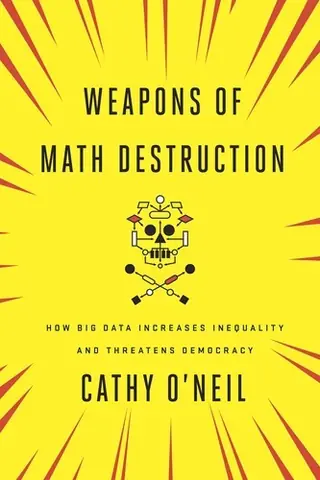
Weapons of Math Destruction summary
by Cathy O'Neil · 2016 · 7 key ideas · 18-minute read
Algorithms that score people for jobs, loans, policing and education can be opaque, unfair and self-reinforcing — quietly deepening inequality while claiming to be objective.
Why read it
For anyone who's been rated by a system they can't see — job applicants, borrowers, students, teachers — and for anyone building data tools who wants to avoid causing harm.
Weapons of Math Destruction in brief
O'Neil, a mathematician who left finance after the 2008 crash, argues that the big-data economy has produced a new kind of harm. Mathematical models now decide who gets hired, who gets a loan, how long someone stays in prison and which teachers keep their jobs. Many are built with good intentions; some are deeply destructive.
She calls the worst of them Weapons of Math Destruction (WMDs). They share three features: they are opaque, so those affected can't see or challenge them; they operate at scale, touching millions of lives; and they cause damage, often to people who are already disadvantaged.
Through case studies — college rankings, predatory advertising, predictive policing, sentencing, hiring, work scheduling, credit and insurance, and political targeting — she shows how WMDs rely on proxies, ignore context and create feedback loops that make their own predictions come true. The poor tend to be judged by machines; the rich, by people.
O'Neil doesn't reject data science. She contrasts WMDs with healthy models that are transparent, use relevant data and learn from their mistakes. She calls for algorithmic audits, regulation, and an ethical commitment from modellers to put fairness alongside efficiency — accepting, where needed, that a fairer model may be a less profitable one.
The 7 key ideas
1. Models are opinions in maths
Behind every model is someone's idea of success.
2. Opacity, scale and damage
Secret, widespread and harmful: that's the danger zone.
3. Feedback loops that justify themselves
A model that makes its own evidence will always look right.
4. Proxies get gamed
Measure the proxy, and the proxy is what you'll get.
5. The poor are processed by machines
The rich get a hearing; the poor get a score.
6. Targeting the vulnerable
Ads that know your pain can sell you more of it.
7. Healthy models and how to fix bad ones
Transparent, relevant, self-correcting — or it's a weapon.
Read the full guide in Kinquire. Every idea with a real example, a diagram and one thing to try today, plus a quick quiz so it sticks. Free to start.
Read Weapons of Math DestructionKey takeaways
- Ask what data a model uses and what it defines as success.
- Watch for proxies that can be gamed, including your own metrics.
- Look for feedback loops where predictions create their own evidence.
- Demand a way to see and appeal automated decisions about you.
- If you build models, add transparency, relevant data and feedback.
Our take
Weapons of Math Destruction is a clear, humane and influential book that helped launch public debate about algorithmic fairness. Its stories are memorable and its three-part test is practical. Its weaknesses: it is light on technical detail, sometimes leans on anecdotes over systematic evidence, and occasionally underplays how biased human decision-making can be, which is the real alternative to many algorithms. Since 2016, audits, fairness research and new laws such as the EU AI Act and New York City's hiring rules have borne out its importance.
About Cathy O'Neil
Cathy O'Neil earned a PhD in mathematics from Harvard, taught at Barnard College, and worked as a quantitative analyst at the hedge fund D. E. Shaw before becoming a data scientist and writer.
If you liked this
- The Alignment Problem by Brian Christian
- The Age of Surveillance Capitalism by Shoshana Zuboff
- Homo Deus by Yuval Noah Harari
- Life 3.0 by Max Tegmark
- Superintelligence by Nick Bostrom
- Human Compatible by Stuart Russell