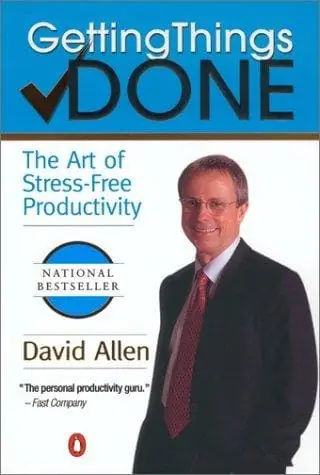
Getting Things Done summary
by David Allen · 2001 · 7 key ideas · 17-minute read
Get every commitment out of your head into a trusted system, decide the next physical action for each, and review it weekly, so your mind is free to focus.
Why read it
For anyone who feels overwhelmed by a pile of half-remembered tasks, emails and ideas. It is the most influential personal workflow system ever written and still the backbone of many productivity apps.
Getting Things Done in brief
Allen starts from a simple observation: most stress at work comes not from having too much to do but from not knowing clearly what all your commitments are and what you should do about them. Every unfinished thing you have agreed to, from 'fix the leaky tap' to 'plan the Q3 launch', is an open loop that your mind keeps tracking, and it does so badly, reminding you at the wrong moments.
The solution is a closed system outside your head. You capture everything that has your attention into a few inboxes. You clarify each item by asking whether it requires action and, if so, what the very next physical action is. You organise the results into lists by context, a projects list, a waiting-for list, a calendar and a someday/maybe list. You review the whole system weekly. Then you engage, choosing what to do moment to moment with confidence.
Allen adds a few powerful details: do anything that takes less than two minutes immediately; define a project as any outcome that needs more than one step; and keep the calendar only for things that truly must happen on a particular day or time. For bigger thinking, he offers a natural planning model and a set of horizons, from today's actions up to life purpose.
The promised result is what he calls 'mind like water': a state of relaxed readiness in which you respond to each new input appropriately, neither overreacting nor ignoring it, because you trust that nothing is slipping through the cracks.
The 7 key ideas
1. Open loops drain you
Your mind is for having ideas, not holding them.
2. Five steps of workflow
Collect it, decide it, park it, review it, do it.
3. Decide the next action
You can't do a project. You can only do the next action.
4. The two-minute rule
Under two minutes? Do it now, not later.
5. Lists by context
Right place, right list, right moment.
6. The weekly review
No weekly review, no trusted system.
7. Horizons of focus
Control the runway first, then look at the horizon.
Read the full guide in Kinquire. Every idea with a real example, a diagram and one thing to try today, plus a quick quiz so it sticks. Free to start.
Read Getting Things DoneKey takeaways
- Do a full mind sweep and get every open loop out of your head.
- Rewrite vague tasks as specific next physical actions starting with a verb.
- Do anything under two minutes while processing; track everything else.
- Keep the calendar only for things that must happen on a particular day or time.
- Hold a weekly review without fail.
Our take
Getting Things Done remains one of the most practical systems ever devised for handling inputs, and ideas like the next action and the two-minute rule have entered everyday language. Its weaknesses: it can become a hobby in itself, with people endlessly tweaking lists instead of working, and it says less about prioritising high-impact, deep work than later authors like Newport and McKeown. Context lists feel dated when most work happens on one device. But its core insight, that a trusted external system frees your mind, has held up well.
About David Allen
David Allen is an American productivity consultant and executive coach who founded the David Allen Company. He published a substantially revised edition of the book in 2015.
If you liked this
- Building a Second Brain by Tiago Forte
- Deep Work by Cal Newport
- Eat That Frog! by Brian Tracy
- Essentialism by Greg McKeown
- Atomic Habits by James Clear
- The Power of Habit by Charles Duhigg