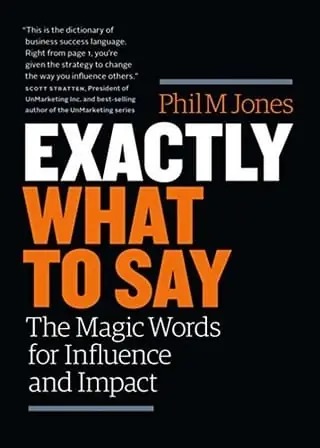
Exactly What to Say summary
by Phil M. Jones · 2017 · 6 key ideas · 15-minute read
A handful of carefully chosen phrases — ‘magic words’ — can lower resistance, spark curiosity and help people decide, because they work with how the mind responds to framing and choice.
Why read it
For anyone who wants practical, word-for-word phrases for sales calls, negotiations and everyday requests. It's a fast read you can apply in your very next conversation.
Exactly What to Say in brief
Jones starts from a simple observation: in persuasive conversations, small differences in wording can produce big differences in response. Certain phrases slip past people's defences, prompting them to consider an idea rather than reject it on reflex. He calls these magic words and presents a couple of dozen of them, each with a brief explanation and example uses.
Many of the phrases lower resistance by giving people a sense of choice: suggesting something might not be for them, or asking how open-minded they are. Others create curiosity, invite people to imagine a better future or to consider the cost of doing nothing.
Further phrases help move conversations forward: presuming the next step, offering a few options instead of a yes-or-no question, and using what most people do as a gentle guide. Another set handles hesitation and objections, by inviting people to share their concerns before they decide.
Jones emphasises that the words are tools, not tricks. They work best when used naturally, with genuine intent to help, and after practice. The aim is to make it easier for people to say yes to something that really serves them — and to make conversations feel more respectful along the way.
The 6 key ideas
1. Lower the guard first
Give them a way out and they'll lean in.
2. Let them find the gap
Their conclusions beat your claims.
3. Paint the future
If they can picture it, they can want it.
4. Presume the next step
Ask when, not whether.
5. Offer options and gentle guides
Three choices beat one question.
6. Invite hesitation into the open
Ask about the no before you answer it.
Read the full guide in Kinquire. Every idea with a real example, a diagram and one thing to try today, plus a quick quiz so it sticks. Free to start.
Read Exactly What to SayKey takeaways
- Open suggestions with a genuine way out to lower defences.
- Ask questions that let people discover their own gaps.
- Help people picture the specific outcome you're offering.
- Ask ‘when’ rather than ‘whether’ once interest is clear.
- Turn yes-or-no questions into three real options.
- Answer objections with ‘What makes you say that?’ before responding.
Our take
Exactly What to Say is short, practical and genuinely handy — many of its phrases can improve conversations immediately. Its limits are the flip side of its strengths: it offers phrases rather than a deep framework, explanations are brief, and the evidence is the author's experience rather than research. Overused or delivered without sincerity, the magic words can sound scripted and manipulative, especially to people who have read the book. Treat it as a phrasebook to adapt to your own voice, not a set of spells.
About Phil M. Jones
Phil M. Jones is a British sales trainer and speaker. Exactly What to Say, a short book of persuasive phrases, is his best-known work.
If you liked this
- Influence by Robert B. Cialdini
- Never Split the Difference by Chris Voss
- To Sell Is Human by Daniel H. Pink
- Pre-Suasion by Robert B. Cialdini
- How to Win Friends and Influence People by Dale Carnegie
- Crucial Conversations by Kerry Patterson, Joseph Grenny, Ron McMillan and Al Switzler