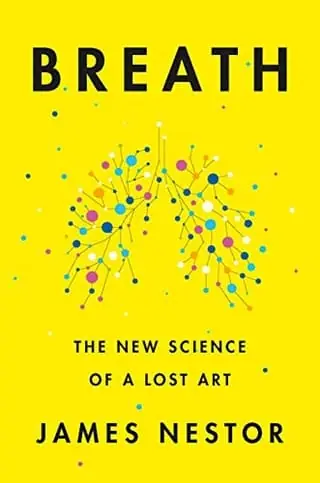
Breath summary
by James Nestor · 2020 · 7 key ideas · 19-minute read
A journalist argues that most of us breathe badly, through the mouth, too fast and too much, and that relearning to breathe through the nose, slowly and fully, can improve health.
Why read it
For anyone curious about a habit they do some 20,000 times a day without thinking. It offers simple breathing practices that are easy to try, though some of its bigger health claims rest on limited evidence.
Breath in brief
Nestor starts from a surprising claim: humans, alone among animals, have become bad at breathing. Our faces and jaws have shrunk over thousands of years, crowding our teeth and narrowing our airways, and many of us now breathe through our mouths, too quickly and too shallowly.
To test how much this matters, he takes part in an experiment at Stanford, blocking his nose for ten days and breathing only through his mouth, then switching back. He reports that his blood pressure rose, his snoring soared and he developed sleep apnoea, and that these improved once he breathed through his nose again.
The core of the book is a set of lessons he collects from scientists, doctors and breathing practitioners, some called 'pulmonauts': breathe through your nose, breathe slower, breathe less, exhale fully, and chew more to build stronger jaws and wider airways.
Later chapters explore more intense techniques, from yogic practices and Tummo breathing to the Wim Hof method, which use deliberate heavy breathing and breath-holds to influence stress, the immune response and mood. He also explores links between breathing, anxiety and the body's sensitivity to carbon dioxide.
The book is vivid and practical, mixing modern research with ancient traditions and colourful characters. Its simple practices are low-risk to try, but some claims, especially about treating chronic disease through breathing, go further than the evidence currently supports, so they are best tested with care.
The 7 key ideas
1. The shrinking face
Soft food, small jaws, narrow airways.
2. Close your mouth
Noses are for breathing; mouths are for eating.
3. Slow it down
Slow breath, calm body.
4. Breathe less
Quiet breaths feed the body best.
5. Exhale all the way
Empty the cup before you fill it.
6. Sometimes, breathe hard
Short, controlled stress builds calm, but stay on dry land.
7. Chew your way to better breathing
Chew more, breathe more.
Read the full guide in Kinquire. Every idea with a real example, a diagram and one thing to try today, plus a quick quiz so it sticks. Free to start.
Read BreathKey takeaways
- Breathe through your nose, day and night, as much as you can.
- Practise a few minutes of slow breathing daily, around five or six breaths a minute.
- Avoid habitual over-breathing; quieter, gentler breaths are often better.
- Exhale fully to make room for a deeper, easier inhale.
- Never practise breath-holds or hyperventilation in water or while driving.
- See a doctor about heavy snoring or suspected sleep apnoea before trying mouth tape.
Our take
Breath brought a neglected topic to millions of readers, and several of its core practices, nasal breathing, slow-paced breathing and full exhales, are low-risk and backed by reasonable evidence for reducing stress and improving comfort. Its weakness is overreach. Nestor leans on small studies, his own two-person experiment and enthusiastic practitioners, and sometimes implies that breathing can treat serious chronic illnesses without strong evidence. Mouth taping and intense breathwork carry risks for some people. Treat the book as an invitation to experiment with simple, safe techniques, and talk to a doctor about any real breathing or sleep problem.
About James Nestor
James Nestor is an American journalist. His previous book, Deep, explored freediving and the ocean.
If you liked this
- Why We Sleep by Matthew Walker
- Spark by John J. Ratey with Eric Hagerman
- Outlive by Peter Attia with Bill Gifford
- Born to Run by Christopher McDougall
- How Not to Die by Michael Greger with Gene Stone
- The Body: A Guide for Occupants by Bill Bryson