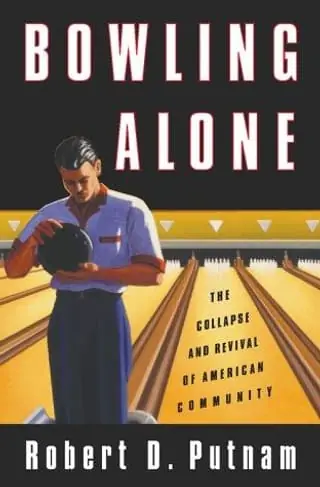
Bowling Alone summary
by Robert D. Putnam · 2000 · 7 key ideas · 18-minute read
Americans' ties to clubs, neighbours, churches and civic life frayed in the last third of the twentieth century, and that loss of social capital affects health, safety, prosperity and democracy.
Why read it
For anyone who senses that community has thinned out and wants to understand why it matters. Its framework of social capital is still one of the most useful lenses on loneliness and civic life.
Bowling Alone in brief
Putnam begins with a striking image: more Americans were bowling than ever, but fewer were bowling in leagues. That small change symbolises a larger one. Across a huge range of measures, from voting and attending public meetings to joining clubs, going to church, having friends over for dinner and playing cards, Americans' involvement with one another rose through the middle of the twentieth century and then declined from around the 1960s and 1970s.
To explain why this matters, he uses the idea of social capital: the networks of relationships, and the trust and norms of reciprocity that come with them, that let people work together. Like physical or human capital, social capital has value for individuals and communities.
Putnam examines possible causes and concludes that the most important were generational change, as a highly civic generation born roughly between 1910 and 1940 was replaced by less engaged ones, and television and other electronic entertainment. Busy schedules, money pressures and suburban sprawl played smaller roles.
He then shows how places with more social capital tend to have better schools, safer streets, healthier and happier people and more responsive government. He ends with a call, inspired by America's Progressive Era reform movement, to rebuild community through new forms of civic life.
The 7 key ideas
1. Social capital
Who you know is a kind of wealth.
2. Bonding and bridging
Bond to get by. Bridge to get ahead.
3. The great civic decline
Paying dues isn't the same as showing up.
4. Why it happened
Every extra minute alone on a screen is a minute not spent together.
5. Why social capital matters
Connection is a health habit, not just a nice extra.
6. The dark side of community
Strong ties need open doors.
7. Rebuilding community
Community isn't found. It's hosted.
Read the full guide in Kinquire. Every idea with a real example, a diagram and one thing to try today, plus a quick quiz so it sticks. Free to start.
Read Bowling AloneKey takeaways
- Invest in relationships deliberately; they are a form of wealth.
- Build both bonding ties for support and bridging ties across differences.
- Choose memberships that involve meeting people, not just paying dues.
- Watch how much leisure time goes to screens alone.
- Host something: small gatherings build community more than big plans.
Our take
Bowling Alone is a landmark of social science, remarkable for the breadth of its data, and it put social capital and loneliness on the public agenda. Critics argued it underplayed new forms of engagement, such as advocacy groups and later online networks, and that its causal estimates rest on correlations. Some saw it as nostalgic for a mid-century America that excluded many people. Putnam addressed some of this, including in his later work. Its core claim, that strong social ties matter for health, safety and democracy, is well supported by later research.
About Robert D. Putnam
Robert D. Putnam is an American political scientist and longtime professor of public policy at Harvard University. Bowling Alone grew out of a 1995 essay of the same name.
If you liked this
- Factfulness by Hans Rosling with Ola Rosling and Anna Rosling Rönnlund
- The Righteous Mind by Jonathan Haidt
- The Anxious Generation by Jonathan Haidt
- Outliers by Malcolm Gladwell
- David and Goliath by Malcolm Gladwell
- Humankind by Rutger Bregman