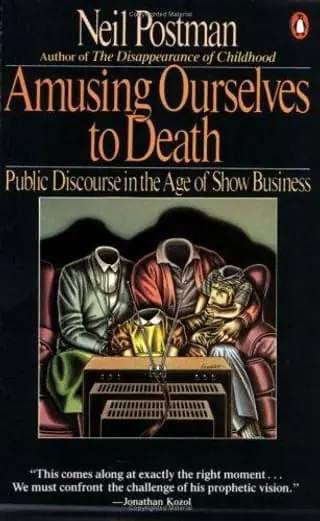
Amusing Ourselves to Death summary
by Neil Postman · 1985 · 7 key ideas · 19-minute read
Television turned public discourse into entertainment, and the real danger to a free society is not censorship but distraction.
Why read it
For anyone who wonders why politics, news and even education feel like show business. Written about TV, it reads today as a warning about every feed and screen.
Amusing Ourselves to Death in brief
Postman opens by contrasting two visions of the future. George Orwell's 1984 feared a state that bans books and hides the truth. Aldous Huxley's Brave New World feared that no one would want to read books, and that people would be drowned in trivia and pleasure. Postman argues that America in the 1980s was living Huxley's nightmare, not Orwell's.
His core claim is that every medium of communication shapes what can be said through it and how we think. A culture built on print, he argues, favoured logic, sequence and sustained argument. He shows how eighteenth- and nineteenth-century America was a deeply print-based society, where even ordinary people sat through hours of complex political debate.
Then came the telegraph and photography, which flooded people with decontextualised information, and finally television, which turned everything into images and entertainment. On TV, he argues, news, politics, religion and education must all be entertaining to survive, and they change their nature to fit.
Postman does not ask people to throw away their televisions. He argues that the real problem is not junk TV, which is harmless, but serious subjects made into entertainment. His remedy is education that teaches people to question how media shape thought.
The 7 key ideas
1. Huxley, not Orwell
We don't need to be censored if we're too amused to care.
2. The medium is the metaphor
Every medium decides what can be said well.
3. The age of exposition
Attention is trained by the media we live in.
4. The peek-a-boo world
More information isn't more understanding.
5. Now... this
Now... this: the end of every thought.
6. Everything becomes show business
Junk TV is harmless. Serious TV pretending is the danger.
7. Ask what the medium is doing to you
Understand the medium, or it will understand you.
Read the full guide in Kinquire. Every idea with a real example, a diagram and one thing to try today, plus a quick quiz so it sticks. Free to start.
Read Amusing Ourselves to DeathKey takeaways
- Notice how each medium you use shapes what you can think about.
- Give serious topics serious formats: long reading, real conversation.
- Check the information-action ratio of your news diet.
- Judge politicians by arguments, not appearances.
- Teach children to question media forms, not just content.
Our take
Amusing Ourselves to Death has proved remarkably prescient: its warnings about trivialised news and image-based politics are widely seen as even more relevant in the age of social media. But critics call it nostalgic and elitist, idealising a print culture that excluded many people and dismissing television's educational and democratic potential. Its claims about Sesame Street, in particular, are at odds with later research. It is a polemic rather than a study, but its core question, how a medium shapes thought, remains essential.
About Neil Postman
Neil Postman was an American cultural critic and professor at New York University, where he founded a programme in media ecology. He also wrote The Disappearance of Childhood and Technopoly.
If you liked this
- Factfulness by Hans Rosling with Ola Rosling and Anna Rosling Rönnlund
- The Righteous Mind by Jonathan Haidt
- The Anxious Generation by Jonathan Haidt
- Outliers by Malcolm Gladwell
- David and Goliath by Malcolm Gladwell
- Humankind by Rutger Bregman