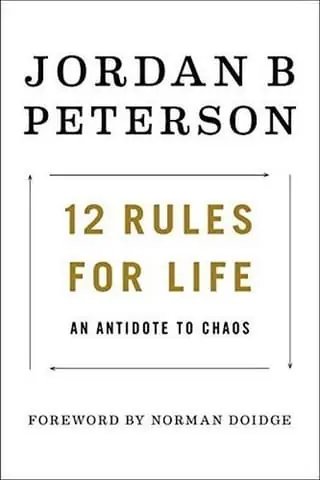
12 Rules for Life summary
by Jordan B. Peterson · 2018 · 8 key ideas · 22-minute read
A psychologist's case that life involves suffering, and that the antidote is taking responsibility, telling the truth and pursuing meaning rather than comfort.
Why read it
For readers looking for a demanding, responsibility-centred philosophy of everyday life, told through psychology, myth and personal stories. It's also one of the most debated self-help books of its decade, so it's worth knowing what it actually says.
12 Rules for Life in brief
Peterson's starting point is that life is hard. Suffering, uncertainty and malevolence are built into existence. He frames this using the old symbols of order, the known and familiar, and chaos, the unknown and unpredictable. A good life, he argues, is lived on the border between them, with one foot in each, and the guide to that border is meaning.
The book offers twelve rules, each with a provocative title, such as Stand up straight with your shoulders back and Pet a cat when you encounter one on the street. Each chapter ranges widely, through evolutionary biology, clinical psychology, Bible stories, literature and Peterson's own life, before returning to a practical point.
The recurring message is responsibility. Treat yourself as someone worth caring for. Choose friends who want the best for you. Compare yourself to who you were yesterday, not to others. Fix what is in your own life before trying to fix the world. Pursue what is meaningful rather than what is expedient. Tell the truth, or at least don't lie. Listen as if the other person knows something you don't.
The tone is earnest and intense. Peterson presents taking on responsibility not as a burden but as the source of meaning that makes suffering bearable. The book has been praised for speaking directly to people, especially young men, who felt adrift, and criticised for its speculative science, its sprawling style and some of its cultural and political views.
The 8 key ideas
1. Stand up straight
Shoulders back means: I'll face whatever comes.
2. Care for yourself like someone you love
Be the carer you'd want for someone you love.
3. Choose friends who want the best for you
Would you recommend this friend to someone you love?
4. Compete with yesterday's you
Beat yesterday. Ignore everyone else's scoreboard.
5. Set your house in order first
Clean your room before you remake the world.
6. Pursue meaning, not expedience
Expedience feels good now. Meaning makes life worth it.
7. Listen as if they know something
Understand first. Then argue.
8. Notice the small graces
Life is hard. Pet the cat anyway.
Read the full guide in Kinquire. Every idea with a real example, a diagram and one thing to try today, plus a quick quiz so it sticks. Free to start.
Read 12 Rules for LifeKey takeaways
- Stand tall and face one responsibility you've been avoiding.
- Treat yourself with the care you'd give someone you love.
- Spend more time with friends who want you to improve.
- Measure your progress against your past self, not against others.
- Before replying in a disagreement, summarise the other person's view to their satisfaction.
- On hard days, notice and record one small good moment.
Our take
12 Rules for Life struck a chord with readers who wanted a call to responsibility, meaning and self-respect, and several of its rules, like comparing yourself to yesterday, listening carefully and fixing your own life first, are sound advice found in many traditions. But it is uneven. The science is often speculative, as with the much-criticised lobster analogy. The chapters are long and digressive, mixing psychology, theology and personal opinion. Some sections contain cultural and political views that many readers find contentious or dismissive, particularly on gender. Peterson's later public persona has also polarised responses to the book. Read it for its practical core, and weigh its bigger claims critically.
About Jordan B. Peterson
Jordan B. Peterson is a Canadian clinical psychologist and former professor of psychology at the University of Toronto. He became widely known through online lectures and public debates before this book became a bestseller.
If you liked this
- Man's Search for Meaning by Viktor E. Frankl
- Meditations by Marcus Aurelius
- The Road Less Traveled by M. Scott Peck
- Letters from a Stoic by Seneca
- The Enchiridion by Epictetus
- The Obstacle Is the Way by Ryan Holiday