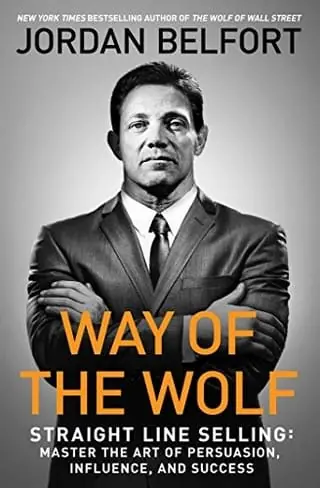
Way of the Wolf summary
by Jordan Belfort · 2017 · 8 key ideas · 20-minute read
Every sale follows a straight line from opening to close, and you keep the prospect on it by building their certainty in three things — the product, you and your company — while managing tone, body language and your own state.
Why read it
For salespeople who want a tightly structured, phone- and pitch-friendly system. It is best read critically, given its author's history, but the framework is clear and widely taught.
Way of the Wolf in brief
Belfort presents the Straight Line System, a sales method he says he developed to train inexperienced young brokers. Its core image is a straight line running from the opening of a sale to the close. Prospects naturally try to drift off it, into stories, tangents and objections. The salesperson's job is to build rapport while steering them gently back towards the line.
The central claim is that people buy when they are sufficiently certain about three things: the product, the salesperson and the company. Belfort calls these the Three Tens — the prospect should feel close to ten out of ten on each. He adds two modifiers: the action threshold, how much certainty a particular person needs before buying, and pain, which can lower that threshold.
To build certainty, Belfort emphasises the first few seconds of contact, tonality, body language and a structured process of gathering information about the prospect's needs. When objections come, he uses looping: acknowledging the concern, then going back to raise certainty in one of the three tens before asking again.
Finally, he turns inward. Salespeople must manage their own emotional state and limiting beliefs, because certainty is transferred from the seller to the buyer. Belfort insists the system should be used only to sell good products to people who will benefit — a point readers will weigh against his past.
The 8 key ideas
1. Every sale is a straight line
Rapport on the way, but always back to the line.
2. The Three Tens
Find the weak ten and fix that one.
3. Action thresholds and pain
Certainty opens the door; pain walks them through.
4. The first four seconds
Sharp, enthusiastic, expert — in four seconds.
5. Tonality and body language
Your tone sells before your words do.
6. Gather intelligence before you pitch
Learn first, then tailor the pitch.
7. Loop back on objections
Don't fight the objection — fix the doubt.
8. Manage your own state
You can't transfer certainty you don't feel.
Read the full guide in Kinquire. Every idea with a real example, a diagram and one thing to try today, plus a quick quiz so it sticks. Free to start.
Read Way of the WolfKey takeaways
- Map your sales conversation as a line and notice when you drift off it.
- Diagnose hesitation by rating certainty in product, you and company.
- Rehearse a sharp, enthusiastic, expert opening line.
- Ask questions before pitching, then tailor everything to what you learn.
- Treat objections as signs of low certainty, not arguments to win.
- Sell only products you'd be proud to sell to someone you love.
Our take
Way of the Wolf offers a clear, memorable structure — the straight line, the Three Tens, looping — that many salespeople find immediately usable. Its weaknesses are serious. The author's history of fraud makes the ethical caveats in the book feel thin, and the system's focus on moving prospects to certainty says little about whether they should buy. Evidence is anecdotal, some techniques rely on neuro-linguistic programming, which has weak scientific support, and the persistent looping approach can easily become high-pressure selling. Useful as a structure; risky as a philosophy.
About Jordan Belfort
Jordan Belfort founded the brokerage Stratton Oakmont and was convicted of securities fraud, serving 22 months in federal prison. His memoir The Wolf of Wall Street was adapted into a Martin Scorsese film; he now works as a sales trainer.
If you liked this
- The Psychology of Selling by Brian Tracy
- Influence by Robert B. Cialdini
- SPIN Selling by Neil Rackham
- The Little Red Book of Selling by Jeffrey Gitomer
- How to Win Friends and Influence People by Dale Carnegie
- Crucial Conversations by Kerry Patterson, Joseph Grenny, Ron McMillan and Al Switzler