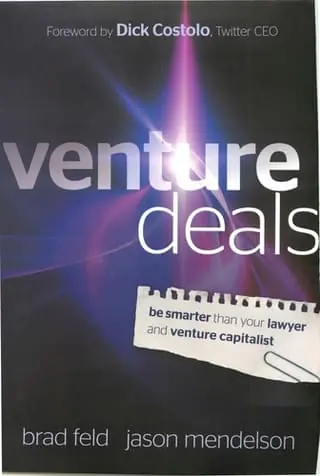
Venture Deals summary
by Brad Feld and Jason Mendelson · 2011 · 8 key ideas · 21-minute read
A venture capital term sheet really comes down to two things, economics and control, and founders who understand each clause can negotiate fair deals with confidence.
Why read it
For founders raising money, early employees with equity and anyone curious how startup investment works. It demystifies the jargon so you can tell which terms truly matter.
Venture Deals in brief
Feld and Mendelson wrote the book to give entrepreneurs the inside view that investors already have. They explain who the players are, from founders and angel investors to venture capitalists and lawyers, and how a typical funding process unfolds, from first pitch to signed term sheet.
Their core message is that, despite the many clauses, only two things in a term sheet really matter: economics, meaning how much money everyone gets when the company is sold or goes public, and control, meaning who gets to make or block decisions along the way.
On economics, they explain valuation and the option pool, liquidation preferences, anti-dilution protection and vesting. On control, they cover board seats, protective provisions and drag-along rights. They also explain convertible notes and how venture funds themselves are structured, which shapes how investors behave.
The final part covers negotiation: prepare, understand the other side's incentives, focus on the terms that matter and aim for a fair deal, because founders and investors will work together for years. Later editions add material on newer instruments and on how deals have evolved.
The 8 key ideas
1. It's all economics and control
Follow the money and the votes.
2. Pre-money, post-money and the option pool
Check where the pool comes from before celebrating the price.
3. Liquidation preferences
In a small exit, preferences decide who eats.
4. Anti-dilution protection
Down rounds hurt; the formula decides how much.
5. Vesting protects everyone
Equity should be earned, not just granted.
6. Who controls the company
Valuation is the headline; control is the story.
7. Convertible notes
Delay the price, but don't ignore the math.
8. Know your investor's incentives
Know what your investor needs, and you'll know what they'll push for.
Read the full guide in Kinquire. Every idea with a real example, a diagram and one thing to try today, plus a quick quiz so it sticks. Free to start.
Read Venture DealsKey takeaways
- Sort every term into economics or control and focus on those.
- Calculate your real ownership after the option pool and any notes convert.
- Model payouts at low, medium and high exit values with all preferences.
- Put vesting on founder shares to protect against co-founder departures.
- Track how board control will shift over future rounds.
- Negotiate for a fair deal, since investors become long-term partners.
Our take
Venture Deals is widely regarded as the clearest guide to startup financing terms; its economics-and-control framework and plain explanations of clauses are genuinely useful, and it is often recommended by both founders and investors. Its limits: it is written from the investor's side of the table, though fairly, and it focuses on US venture deals, so laws and norms elsewhere may differ. Market terms shift with funding cycles, so specific norms date quickly, which is why it has been updated in several editions. It explains mechanics more than strategy, such as whether to raise venture money at all.
About Brad Feld and Jason Mendelson
Brad Feld and Jason Mendelson are venture capitalists who co-founded the Colorado-based firm Foundry Group. Feld is also a co-founder of the startup accelerator Techstars.
If you liked this
- The Hard Thing About Hard Things by Ben Horowitz
- Zero to One by Peter Thiel with Blake Masters
- The Lean Startup by Eric Ries
- The E-Myth Revisited by Michael E. Gerber
- $100M Offers by Alex Hormozi
- $100M Leads by Alex Hormozi